Simulating student learning for better AI tutoring
StudentSim is a research system for evaluating and improving AI tutoring tools before they are tested with learners. It models how individuals may engage with tutors, giving feedback to improve tutor performance across subjects like chess, writing, and mathematics. The post Simulating student learning for better AI…
At a glance
- StudentSim is a research system for evaluating and improving AI tutors before they are tested with real learners; it is not a product, is not deployed in classrooms, and is not intended to replace teachers
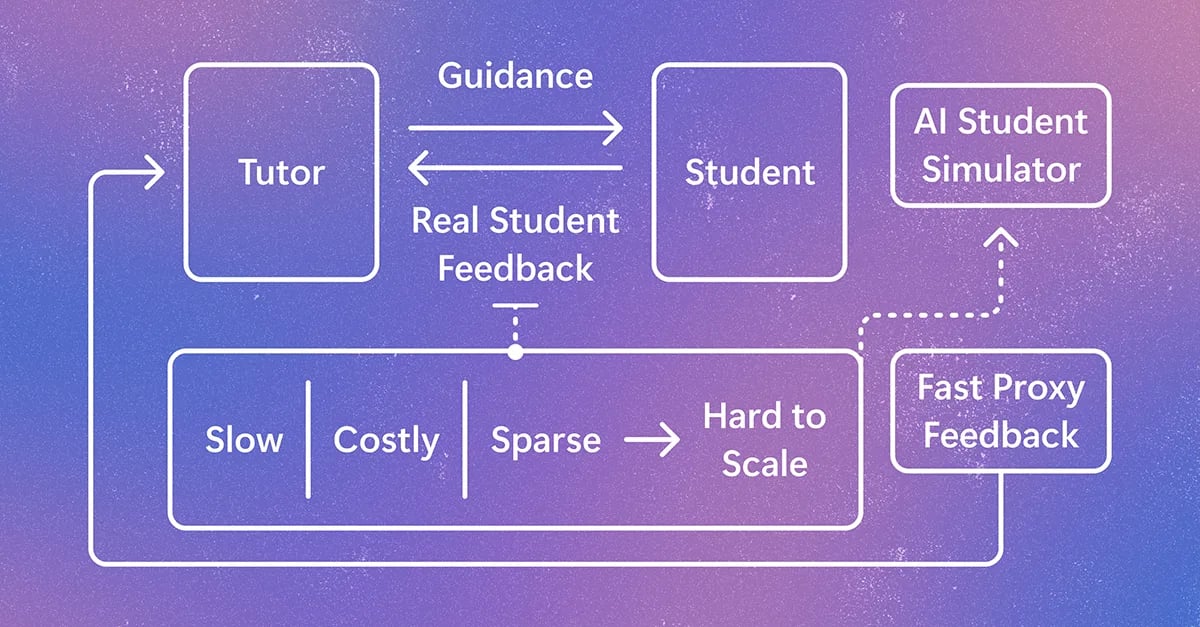
- AI tutoring tools need feedback from students to improve, but collecting that feedback through human studies is slow, costly, and difficult to scale
- StudentSim trains personalized AI student simulators from publicly available, de-identified learner records, with one simulator adapted to each student
- The work evaluates simulators along two education-grounded dimensions: whether they respond like a specific student, and whether they update after tutor guidance
- Across chess, second-language English writing, and mathematics, StudentSim outperforms leading baselines and provides a useful feedback signal for training an AI tutor
In research settings, teams are exploring how AI-powered tutoring systems can help explain a math problem, suggest an edit to a writing assignment, or guide a learner through a chess position. Yet the quality of teaching cannot be measured only from the tutor’s answer. A tutor needs to know what happens after the guidance reaches a student. Did the student correct the original mistake? Did the hint help them reason toward the answer, or did it give away too much? Would a different student need a different kind of support? In today’s AI tutor research, answering these questions often requires real learner studies. Those studies are valuable, but they are slow and costly to run, which makes it hard to use student feedback during fast model iteration.
Keep reading Microsoft Research with Pro
This source is part of the Pro library. Unlock every premium source, AI translation and custom feeds.
Originally published on
Microsoft Research
Keep reading