Accelerating PyTorch on AMD GPUs with FlyDSL
PyTorch users on AMD MI350 series GPUs can now use FlyDSL through existing operator APIs for dense and grouped GEMM, fused multi head attention (FMHA/Attention), MXFP8/MXFP4 scaled GEMM, RMSNorm, and TopK, without... The post Accelerating PyTorch on AMD GPUs with FlyDSL appeared first on PyTorch .

PyTorch users on AMD MI350-series GPUs can now use FlyDSL through existing operator APIs for dense and grouped GEMM, fused multi-head attention (FMHA/Attention), MXFP8/MXFP4 scaled GEMM, RMSNorm, and TopK, without requiring applications to call custom kernels. The optional backend supports GEMMs through torch.compile, while eligible RMSNorm and TopK calls dispatch automatically in eager mode when it is available and enabled. Unsupported inputs retain existing PyTorch implementations. FlyDSL attention kernels ship as an additional backend in AOTriton, the library behind PyTorch’s ROCm F.scaled_dot_product_attention (SDPA), starting with the 0.14b series.
Across the reported kernel-level operator suites, FlyDSL provides a 1.10x geometric-mean speedup for the 15-shape BF16 dense-GEMM suite over the faster of ATen and Triton at each shape, 1.58x and 1.68x geometric-mean speedups for MXFP8 and MXFP4, respectively, over ATen across 17 shapes per format, 1.20x geometric mean over Triton across all 24 grouped-GEMM cases, and 1.17x–3.66x over ATen across the 22 RMSNorm cases. For the 10 small-K TopK cases, the geometric mean is 4.82x over ATen with deterministic algorithms disabled. These gains are most relevant when the supported operations account for a significant share of model runtime. For attention, AOTriton 0.14.2b’s published gfx950 throughput ranges from 0.92x to 2.34x of 0.13b for forward and 0.93x to 2.47x for backward, across head dimensions and causal modes. In end-to-end vLLM A/B tests, whole-request speedup reaches 1.13x for BF16, 2.04x for MXFP8, and 3.01x for MXFP4, with the result depending on model and concurrency.
Why FlyDSL as a PyTorch Backend
GPU DSLs choose different abstraction levels. The block-tensor programming model in Triton lets authors describe program-level tiles while the compiler manages much of the thread, wave, and instruction mapping. FlyDSL makes those mappings explicit through layout algebra: kernel authors can partition tiles across blocks, waves, threads, and values; select tiled-copy and MFMA atoms; define LDS swizzles and staging; and place synchronization or compiler-scheduling boundaries. The two approaches are complementary. FlyDSL is useful for architecture-specific templates where data movement and instruction ownership are part of the algorithm.
These controls appear directly in the kernels: HTI and staged LDS in Dense/MXFP GEMM, matched operand-scale lifetimes and scaled MFMA in MXFP, and persistent expert scheduling in Grouped GEMM. FlyDSL expresses them in Python and lowers them through MLIR while preserving explicit hardware mapping.
Attention shows why this control matters. The FlyDSL attention kernels use a dual-wave software pipeline, which overlaps the softmax VALU work of one KV tile with the MFMA work of another. At the largest head dimensions, they also split the head dimension: in time through LDS, and across waves for the output accumulator. In FlyDSL, both schedules are written in the kernel itself, so they can be developed and tuned per architecture without changes to the compiler.
PyTorch turns those specialized templates into an additive, measurable backend. Unsupported workloads retain existing implementations:
- Eager execution: eligible RMSNorm and TopK calls dispatch to FlyDSL when the optional runtime is installed and enabled; other calls retain ATen.
torch.compile: TorchInductor filters eligible Dense, Grouped, and MXFP GEMM candidates, benchmarks FlyDSL beside ATen and Triton where supported, caches the winner for each workload, and runs the fastest measured kernel.- Multi-head attention: PyTorch’s built-in operator
F.scaled_dot_product_attentioncalls AOTriton, which now picks among FlyDSL, Triton, and AITER ASM kernels for each workload using its offline operator-tuning database.
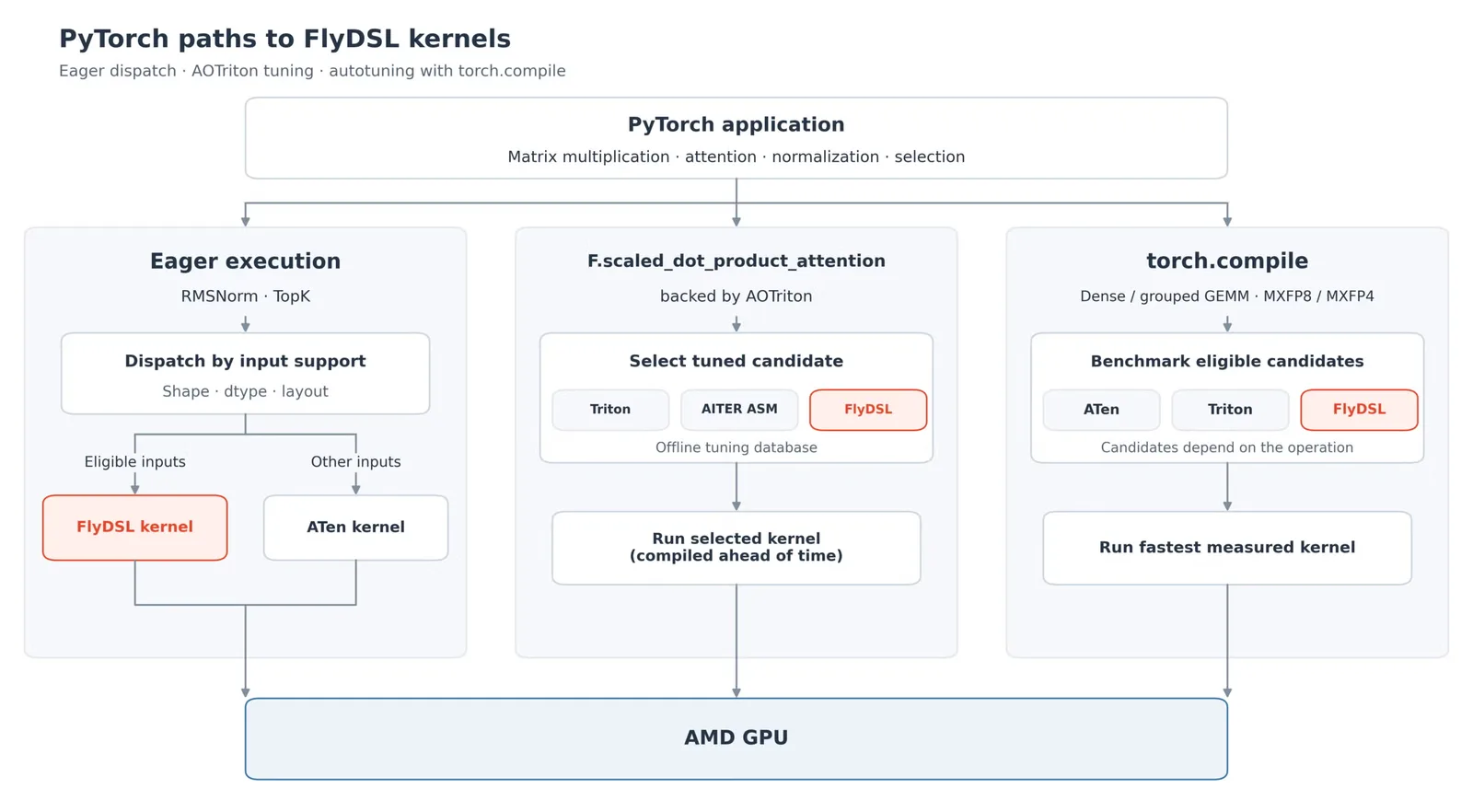
Figure 1. FlyDSL kernels reached through PyTorch APIs. Eager RMSNorm and TopK dispatch by input support; AOTriton selects a tuned SDPA implementation; and TorchInductor benchmarks eligible GEMM candidates.
Supported Features
Current support targets AMD MI350-series GPUs with the gfx950 architecture. The following features are available in PyTorch:
| Operation | Mode | PyTorch API | Input dtype | Layout / shape | Output / options |
|---|---|---|---|---|---|
| Dense GEMM | Compile | torch.mm | FP16, BF16 | Static 2D; NN/NT/TN/TT | Same dtype |
| MXFP scaled GEMM | Compile | F.scaled_mm | MXFP8, MXFP4 | Static 2D; A row-major, B column-major | FP16/BF16; block scales |
| Grouped GEMM | Compile | F.grouped_mm | FP16, BF16 | Ragged 2D A; grouped 3D B | Uneven/empty groups |
| RMSNorm | Eager | F.rms_norm | FP16, BF16, FP32 | Contiguous; 1-D norm shape | Forward |
| TopK | Eager | torch.topk | FP32 | Contiguous; last dimension | Largest, sorted; functional/out= |
| Attention (via AOTriton) | Eager, compile | F.scaled_dot_product_attention | FP16, BF16 | D innermost; head dim 32–512 | Forward and backward |
Dense GEMM’s four-layout support accepts row-major and column-major inputs, including eligible transpose views. In the layout names, the first letter describes A and the second describes B; N and T denote non-transposed and transposed input layouts. Grouped GEMM supports different row counts per group, allowing experts to process uneven token assignments. Its current input-layout requirements are separate from dense GEMM’s four-layout coverage. RMSNorm backward continues through PyTorch’s existing implementation.
MXFP scaled GEMM accepts FP8 E4M3 or packed FP4 E2M1 operands, with one E8M0 scale per 32 values along the reduction dimension (BlockWise1x32). Applications supply the quantized operands and contiguous, unswizzled scale tensors. Both formats use FP32 accumulation and return FP16 or BF16; the current path requires K to be a multiple of 128. It supports an optional one-dimensional bias whose length is N and whose dtype matches the output; fast accumulation is not supported. Under torch.compile, Inductor’s layout constraint runs before backend selection and requires unit stride along K for A and B—row-major A and column-major B—while preserving compatible leading strides. For incompatible inputs, Inductor inserts a layout copy. The FlyDSL MXFP kernel and the measurements below use these constrained layouts. This constraint is specific to scaled GEMM: Dense torch.mm detects eligible NN/NT/TN/TT strides and passes their layout flags to FlyDSL without applying the MXFP canonicalization.
The FlyDSL attention kernels match the flash and memory-efficient attention capabilities of F.scaled_dot_product_attention, with one current limit: FP32 is not supported. FP32 inputs, and workloads that the tuning database assigns elsewhere, keep AOTriton’s Triton or AITER ASM kernels. AOTriton also ships FlyDSL attention kernels for RDNA4 (gfx1201). Under torch.compile, Inductor keeps SDPA’s flash and memory-efficient attention operators as calls to ATen rather than generating code for them, so they still reach the AOTriton kernels. Hand-written matmul–softmax–matmul patterns that Inductor rewrites into SDPA follow the same path. By contrast, torch.nn.attention.flex_attention is a separate API that Inductor compiles into its own Triton kernels; it does not use AOTriton.
Each operation has shape and alignment requirements. The detailed dense GEMM, MXFP scaled GEMM, grouped GEMM, RMSNorm, and TopK support descriptions define those boundaries. Unsupported eager calls retain ATen behavior; compiled GEMMs can use the other enabled backends. The AOTriton 0.14.2b update brings these kernels to PyTorch.
Kernel-Level Performance
The following operator-level benchmarks were measured on AMD Instinct MI355X (gfx950) GPUs. The suites use different benchmark setups: dense GEMM uses GPU-event timing of graph replay, grouped GEMM reports steady-state throughput, and RMSNorm and TopK use GPU-event timing of repeated operator calls. The results focus on steady-state operator execution, excluding compilation and initial autotuning; they do not represent end-to-end model latency. MXFP measurements start from already quantized operands, so input quantization is outside the timed region. A speedup above 1.0 means FlyDSL is faster than the named baseline, and geometric means give equal weight to each sampled case. Each figure and caption specifies its baseline and aggregation scope.
Dense GEMM: Linear-Layer Workloads
Dense matrix multiplication is a building block of transformer projection and feed-forward layers. Its dimensions vary substantially with the number of tokens being processed, making performance across a range of shapes relevant to model developers.
FlyDSL provides full-tile and half-tile interleaved (HTI) execution paths. The full-tile path uses a configurable STAGES-deep K-tile ring in local data share (LDS). Its prologue primes the ring, the steady-state loop overlaps computation on staged data with asynchronous prefetches into reusable slots, and the final iterations drain the remaining stages. For a step-by-step explanation of this producer/consumer pattern and its wait semantics, see AMD’s Multi-Stage LDS Pipeline: Keep K Blocks in Flight.
For large GEMMs, the tuned HTI configurations use a 256 × 256 output tile and an eight-wave workgroup (512 threads with Wave64). HTI splits A along M and B along N, maintaining four 128 × 128 output-quadrant accumulators in registers. Within each K tile, A0 feeds C00/C01, A1 feeds C10/C11, B0 feeds C00/C10, and B1 feeds C01/C11. Smaller shapes can autotune among narrower full-tile and HTI configurations.
HTI processes consecutive K tiles in pairs using two LDS stages. In steady state, prefetches progressively reuse the stages holding t and t+1 for t+2 and t+3. Reuse occurs half by half: once the required reads of an operand half’s old LDS contents are complete and synchronization requirements are met, its region can be refilled while matrix fused multiply-add (MFMA) computation continues on register-resident fragments. Within the same compute unit (CU), a phase-shifted barrier schedule staggers the workgroup’s two four-wave groups, overlapping MFMA computation in one group with operand loading and asynchronous prefetching in the other. Both groups alternate between these activities, combining half-tile buffer reuse with staggered execution rather than waiting for an entire tile’s computation to finish.
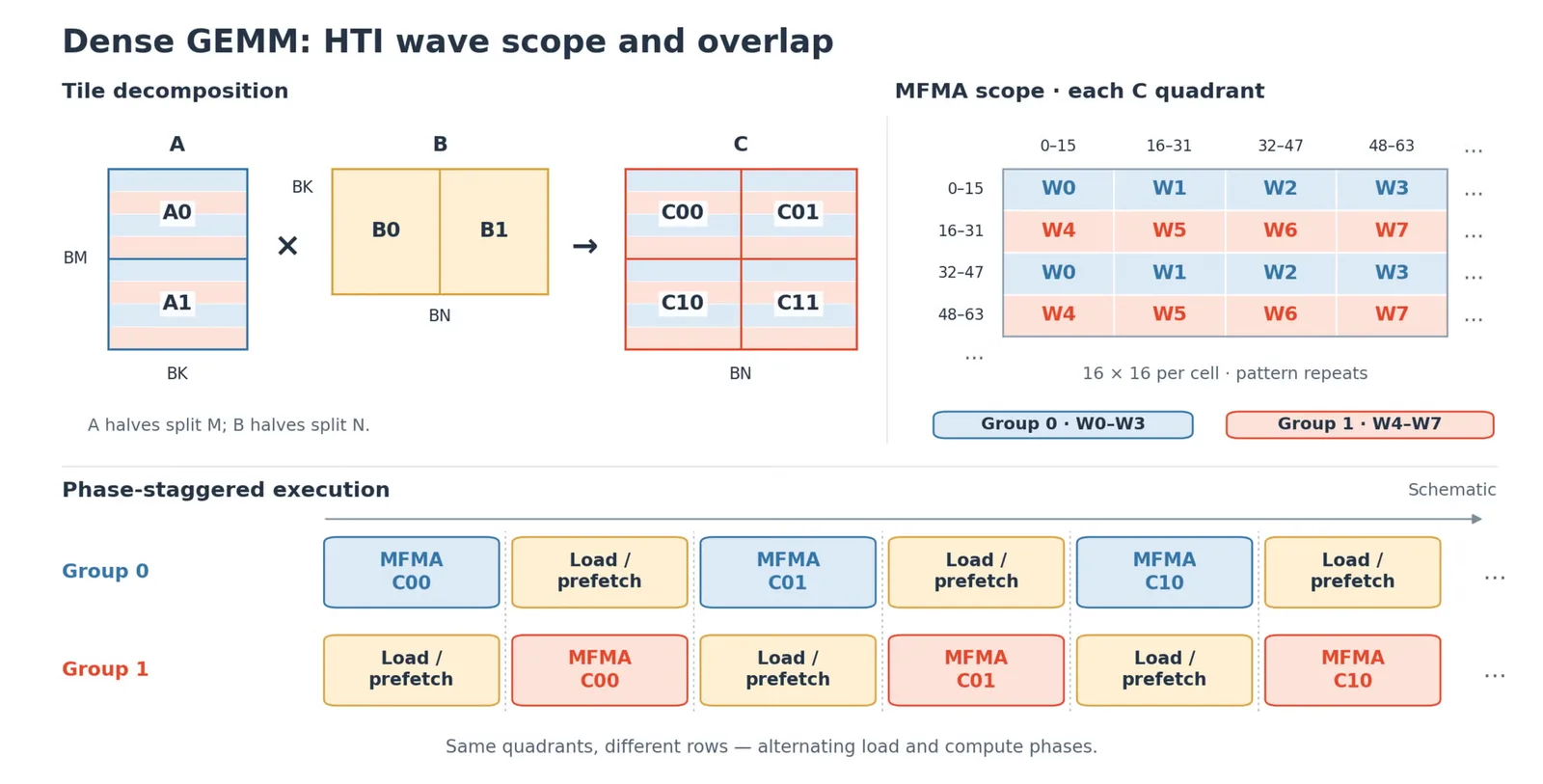
Figure 2. HTI wave scope and phase-staggered execution, shown with two groups of four Wave64 waves. Each grid cell is a 16 × 16 output block. Waves per group are tunable with the tile configuration, subject to kernel constraints.
Across 15 BF16 NT shapes, FlyDSL delivers a 1.10x geometric-mean speedup over the faster ATen/Triton baseline at each shape. Gains are strongest in smaller and medium-sized problems: M × N × K = 64 × 4096 × 4096, for example, improves by 1.33x.
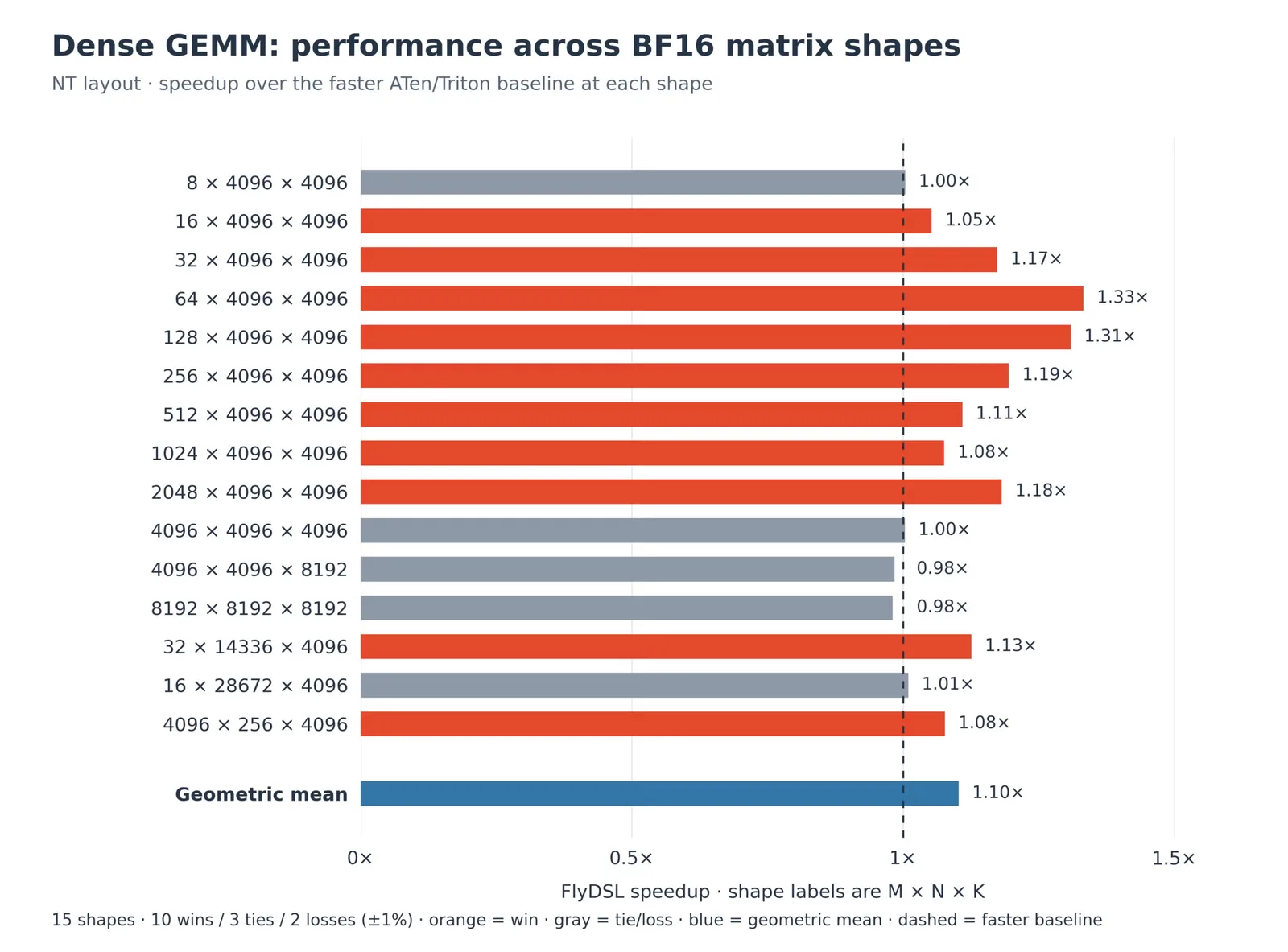
Figure 3. BF16 NT GEMM on MI355, relative to the faster ATen/Triton baseline at each shape. All 15 cases are shown: 10 wins, three ties, and two losses using a ±1% tie band.
A later regression check of the current all-layout kernel over the same shapes reported a 1.12x aggregate speedup over the faster original baseline. Figure 3 retains the earlier per-shape measurements because the later check published aggregate results only.
The two largest square-output problems in this suite slightly favor ATen. Keeping multiple backends enabled lets PyTorch make that choice for each workload. These results characterize NT GEMM; NN, TN, and TT are also supported, with their performance depending on the workload.
MXFP Scaled GEMM: Extending to Low-Precision Workloads
MXFP extends the shared gfx950 full-tile and HTI GEMM implementations with FP8 operand handling, packed FP4 storage, E8M0 scale staging, and CDNA4 scaled MFMA.
In HTI, A/B buffers advance by K tile, while separate scale slots hold chunks spanning multiple K tiles. Each MFMA uses register-resident operands and the matching scales for its K position. At chunk boundaries, waits and barriers coordinate reuse of the other scale slot to prefetch the next chunk while the current chunk is consumed. Chunk length depends on tile and workgroup geometry; the four-tile chunk below is an example, not a fixed format requirement. The full-tile path instead stages each K tile’s scales in separate LDS buffers using the same stage index as A/B.
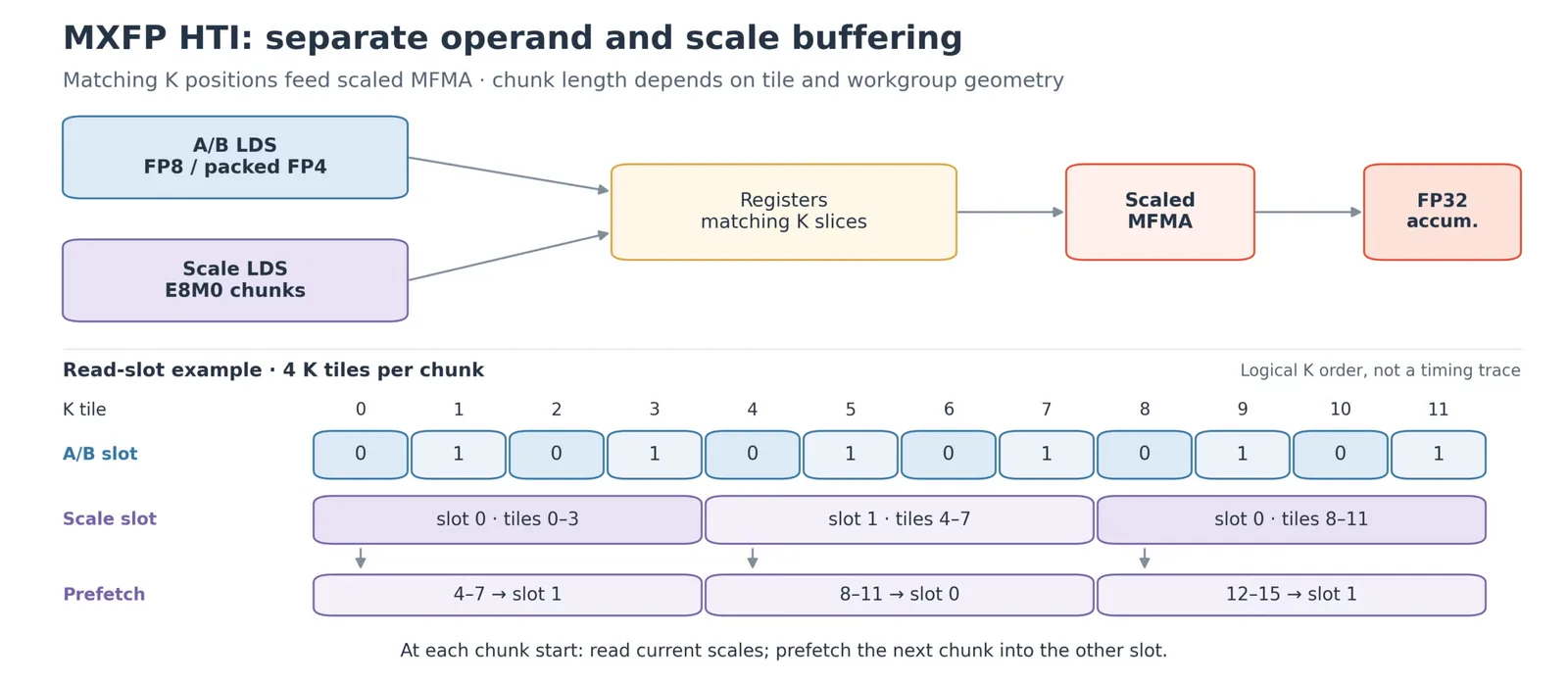
Figure 4. MXFP HTI buffering, shown with four K tiles per scale chunk. A/B read slots alternate per tile; scale read slots alternate per chunk. The next scale chunk is prefetched into the other slot at each chunk boundary.
On MI355X, the 17-shape NT suite shows a 1.58x geometric-mean speedup for MXFP8 over ATen and a 1.68x speedup for MXFP4 over ATen.
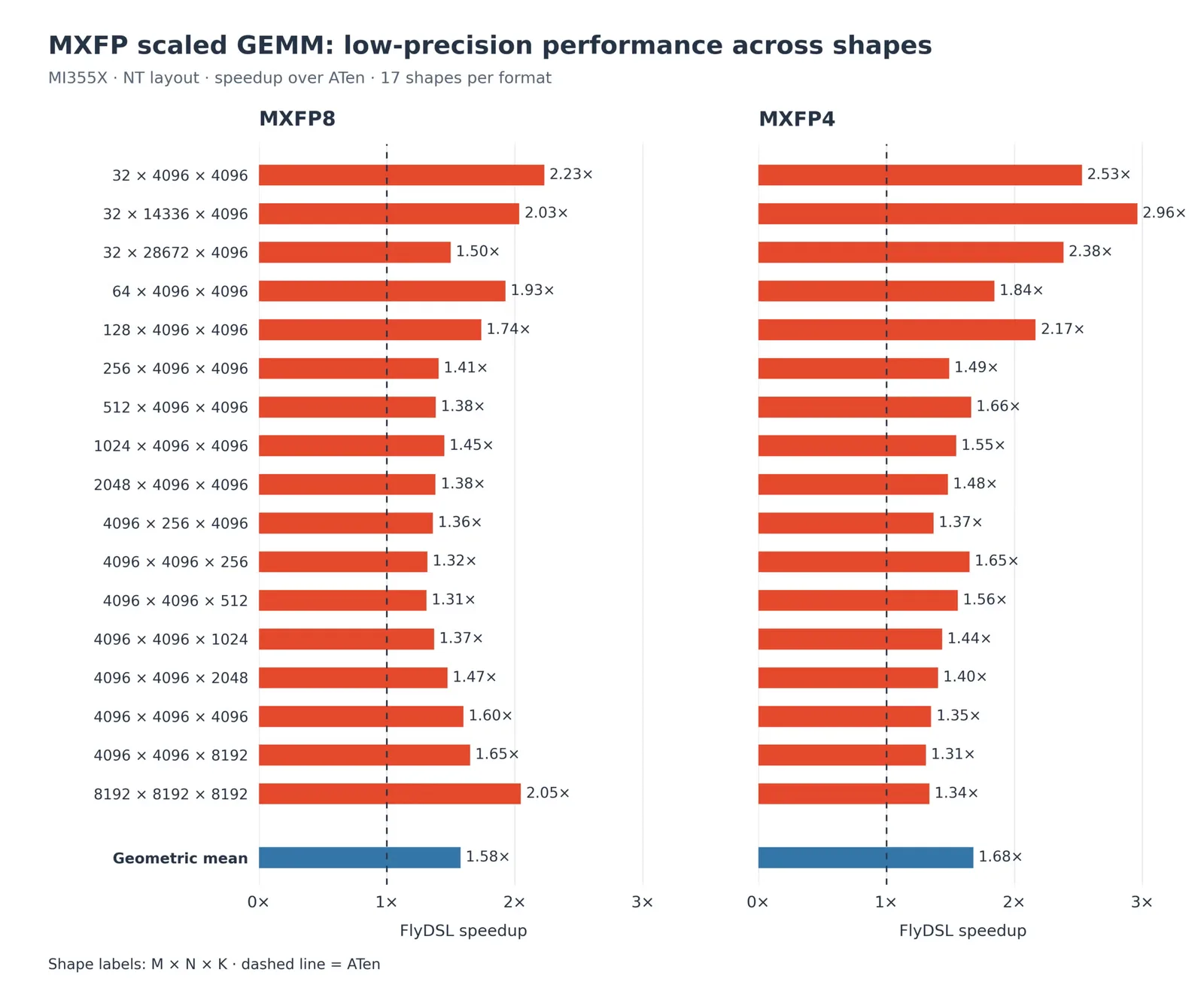
Figure 5. NT scaled GEMM on MI355X. Each panel shows all 17 cases and their geometric mean relative to ATen.
FlyDSL exceeds ATen throughput in every reported case for both formats. MXFP8 speedups range from 1.31x to 2.23x, with the largest gain at 32 × 4096 × 4096. MXFP4 ranges from 1.31x to 2.96x, peaking at 32 × 14336 × 4096. The MXFP autotuning path benchmarks FlyDSL alongside ATen when both backends are enabled and applicable. The measurements cover NT layout.
Grouped GEMM: Uneven Work Across Experts
In mixture-of-experts models, experts can receive very different numbers of tokens. Grouped GEMM processes these matrix multiplications together while accommodating uneven—and sometimes empty—groups. PyTorch represents the inputs as concatenated activations A[sum(M_g), K], grouped weights B[G, K, N], and offsets that mark each expert’s row boundary.
Instead of launching one kernel per expert, a persistent grid assigns every workgroup a strided sequence of tiles across the cumulative group offsets, naturally skipping empty groups. A compute-die-aware swizzle distributes work across the GPU’s eight Accelerator Complex Dies (XCDs), with an N-major fallback that keeps concurrent workgroups on reusable B tiles; HTI configurations remain available to autotuning.
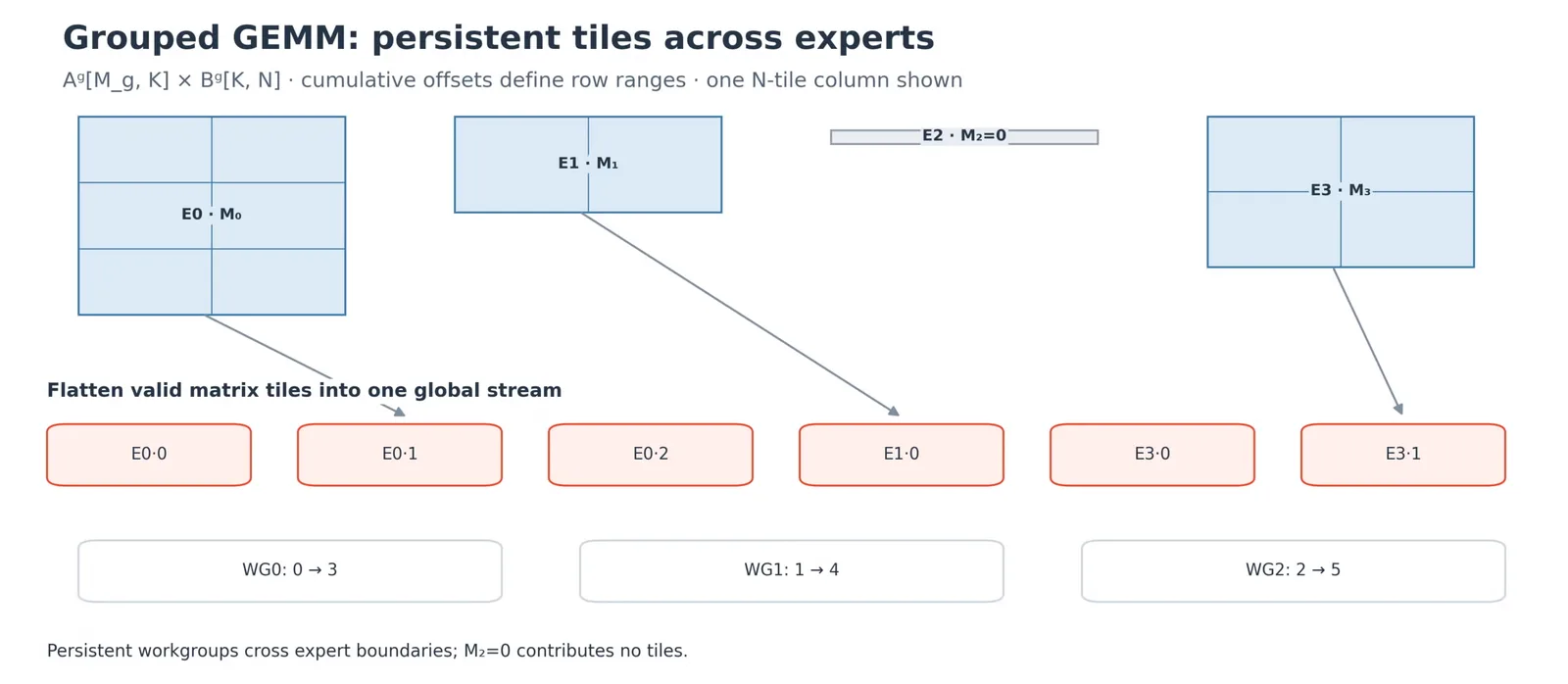
Figure 6. Grouped-GEMM scheduling. One N-tile column is shown: experts contribute ceil(M_g / BM) tiles to a cumulative stream, while a zero-row expert contributes none. Persistent workgroups start at blockIdx.x and advance by the grid size, so they can cross expert boundaries without launching per expert.
The 24 reported cases are divided by the workload dimension being tested. In a uniform shape G × M × K × N, G is the number of experts, M is the token count per expert, and K and N are the reduction and output dimensions:
- Uniform groups (14 cases): all experts use the same
M, whileG,M,K, andNvary across common grouped-GEMM shapes. - Projection dimensions (five cases):
G = 8andM = 512are fixed whileKandNcover MoE up/down projections and a small-Ncase. - Ragged expert loads (five cases):
G = 8andK = N = 4096are fixed, while each label lists the eight per-expertMvalues, including empty and highly imbalanced experts.
Across all 24 cases, FlyDSL reaches 1.20x geometric-mean speedup over Triton and 1.95x over ATen. Uniform groups reach 1.21x and 2.12x, respectively, with FlyDSL the fastest backend in 11 of 14 cases. The projection-dimension cases reach 1.23x and 1.73x; the ragged cases reach 1.15x and 1.73x, and FlyDSL wins all five.
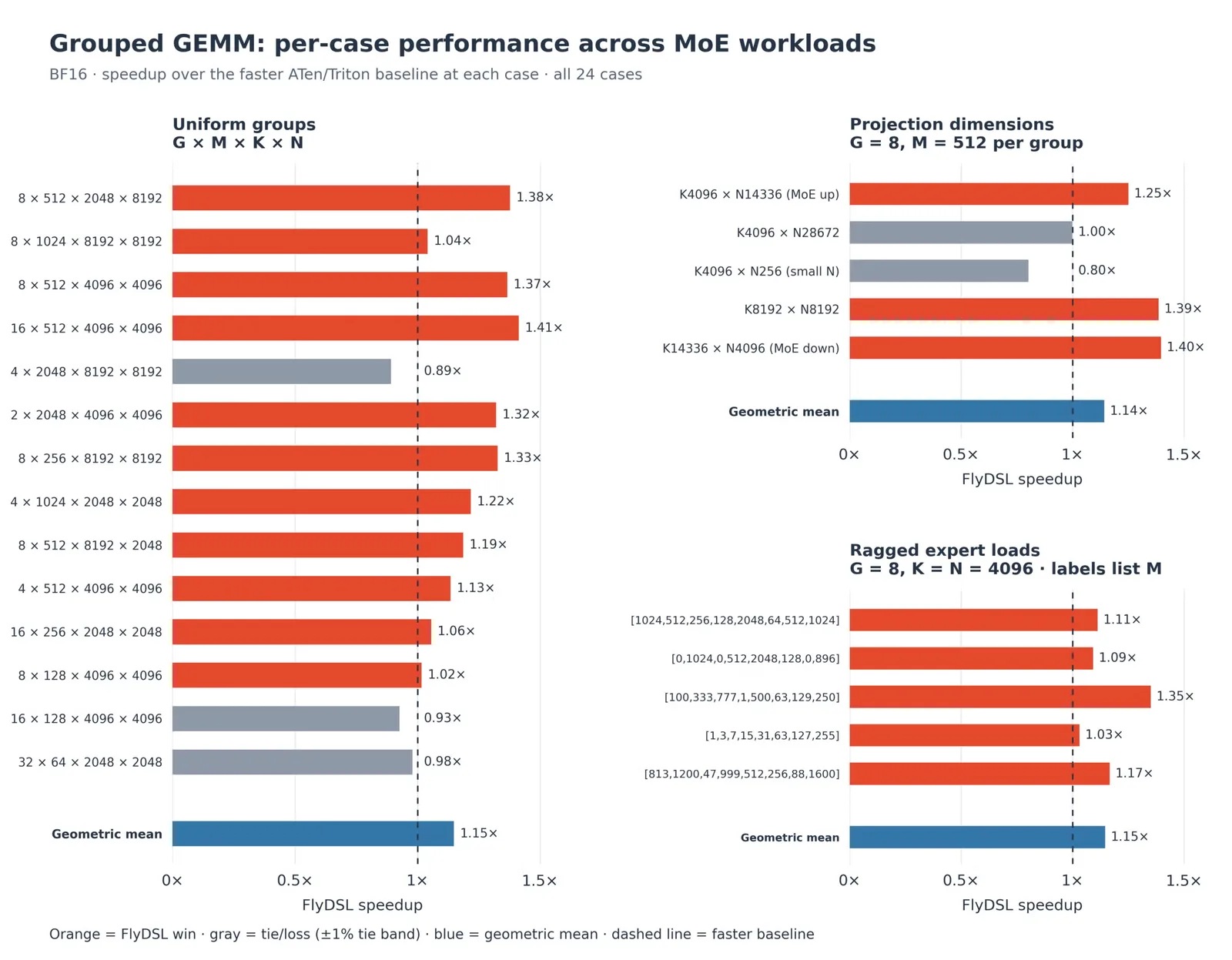
Figure 7. All 24 BF16 grouped-GEMM cases on gfx950, split into three panels. Each bar compares FlyDSL with the faster ATen/Triton result for that case; each panel ends with its geometric mean.
The per-case view makes the shape sensitivity explicit: the projection sweep contains a small-N case where Triton is faster and a wide-N case tied with ATen, while all five ragged expert-load cases favor FlyDSL.
RMSNorm: Gains Across Hidden Dimensions
RMSNorm normalizes and scales activations, a repeated step in many transformer models. FlyDSL accelerates the forward operation while retaining the normal PyTorch API and backward behavior.
The kernel assigns one thread block (CTA) to each row and chooses 256, 512, or 1024 threads from the normalized dimension, corresponding to 4, 8, or 16 Wave64s. It loads the vectorizable body with 128-bit copies, handles any remaining elements with a scalar tail, and keeps the loaded input in registers. FP32 sum-of-squares first reduces within each Wave64 using shuffle operations, then combines one partial per wave through a small LDS buffer. The resident values are reused to apply rsqrt and the weight and to return the rstd needed by backward.
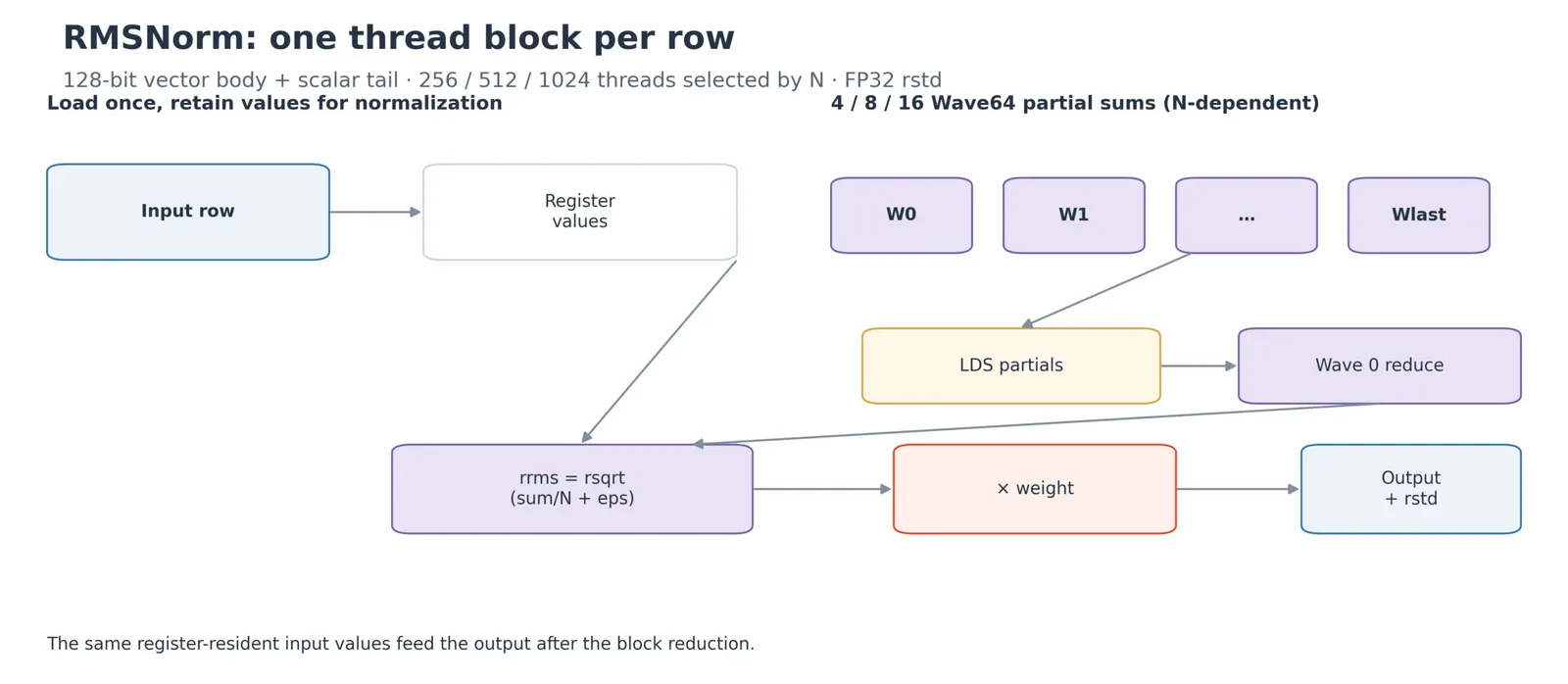
Figure 8. RMSNorm scheduling. One thread block loads a row into registers, produces 4/8/16 Wave64 partial sums depending on N, combines them through LDS, then reuses the resident values to write the normalized output and backward rstd.
For the measured aligned hidden dimensions, speedups over ATen are approximately 1.2x–1.5x. Dimensions one element above an aligned size—for example, 4097 rather than 4096—show larger gains, reaching 3.66x.
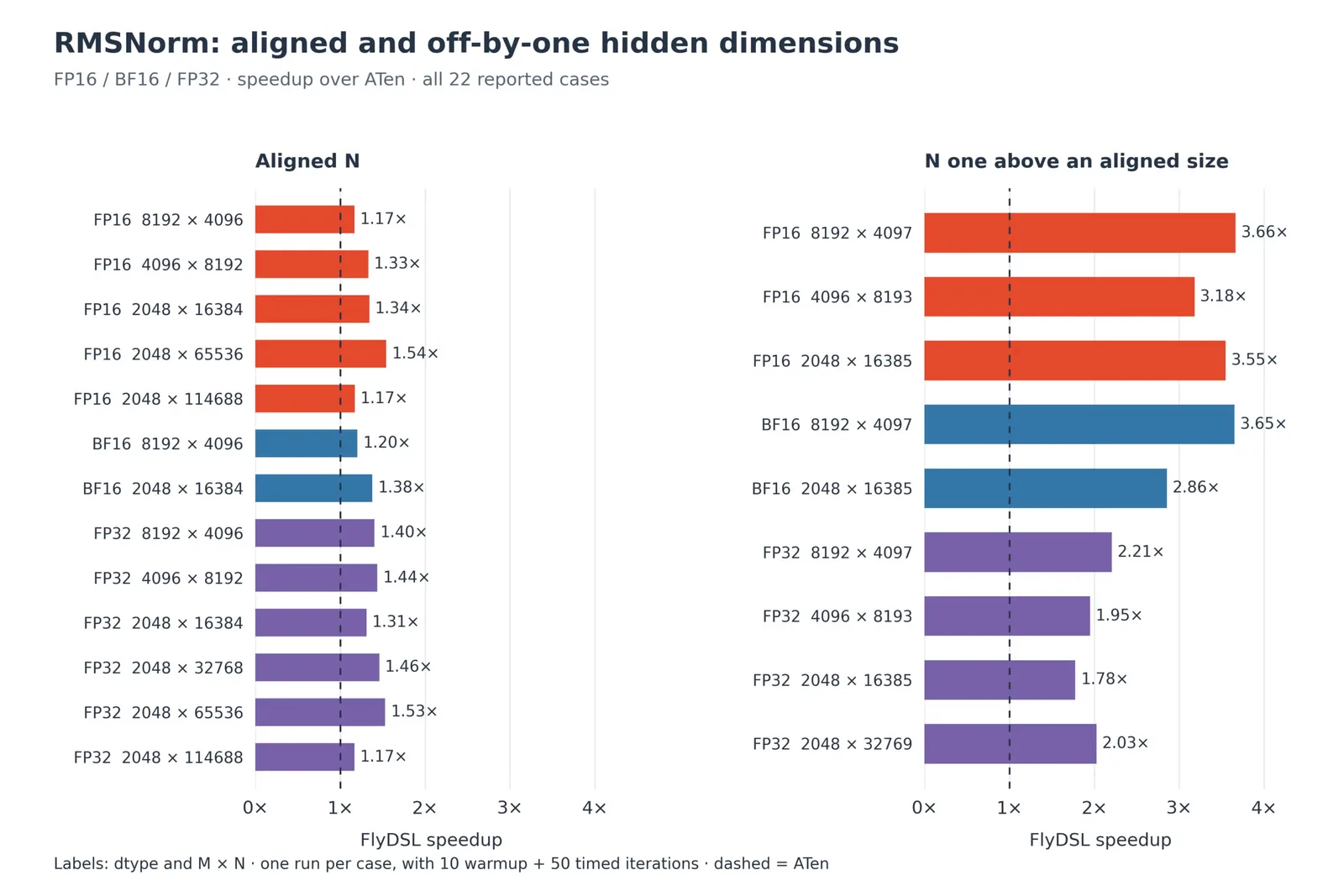
Figure 9. All 22 reported RMSNorm cases on MI355X. Labels identify dtype and M × N, where M is the row count and N the normalized dimension. Both panels use the same speedup scale.
The split between aligned and off-by-one dimensions shows why the input shape matters when interpreting the peak result. The 3.66x speedup applies to a particular FP16 case; gains on aligned dimensions are more modest.
TopK: Faster Selection for Small and Large K
TopK selects the highest-scoring elements from each row. The amount of output requested changes the workload: selecting a handful of elements is different from selecting hundreds. FlyDSL provides specialized paths for these regimes. For small fixed K, a gfx950 CTA contains two Wave64s and processes two rows—one wave per row. Each lane reads 128-bit chunks, bitonic-sorts one group at a time, and folds each group into a register-resident local top-K. Butterfly shuffles then merge those candidates across the wave, and lane 0 writes the final K pairs. For larger K, four 8-bit radix passes find the K-th threshold, gather only the surviving candidates, and bitonic-sort a buffer rounded from K to the next power of two instead of sorting the full row.
Here, “determinism on” means torch.use_deterministic_algorithms(True). The radix path then uses prefix-sum slots to preserve finite-value tie order; with determinism off it uses atomic slot allocation, so equal-value indices can vary. The register kernel itself is reproducible in both modes, although its tie ordering can differ from ATen. NaNs are canonicalized to one ordinal, so exact NaN payload and index selection can differ from ATen even in deterministic mode.
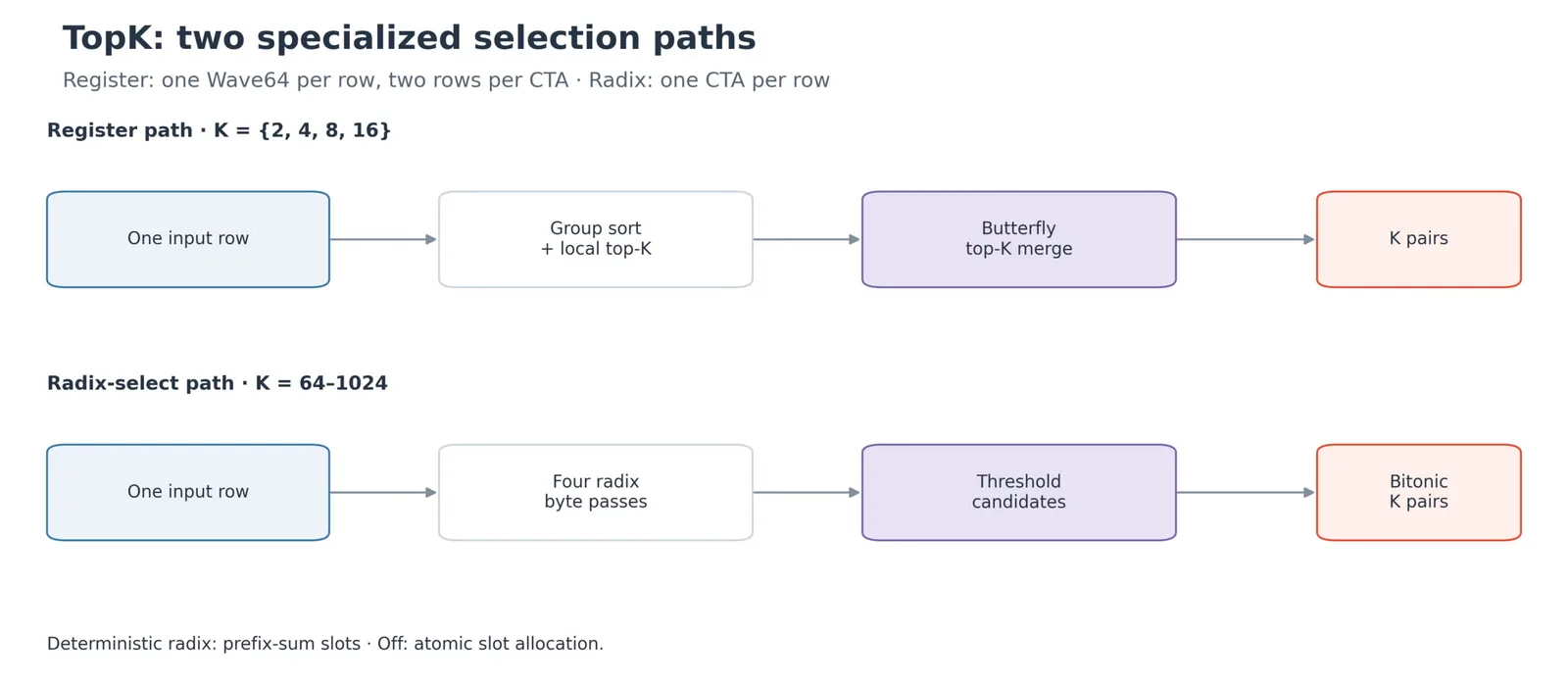
Figure 10. TopK scheduling. The register path processes two rows per CTA with one Wave64 per row, then butterfly-merges local top-K candidates. The radix path uses one CTA per row and four byte passes to identify a threshold before sorting only the surviving candidates.
For small K = {2, 4, 8, 16}, FlyDSL achieves a 4.82x geometric-mean speedup over ATen with deterministic algorithms disabled, and 4.02x with them enabled. For the larger sampled K bands, the geometric-mean speedup ranges from 1.40x to 1.97x.
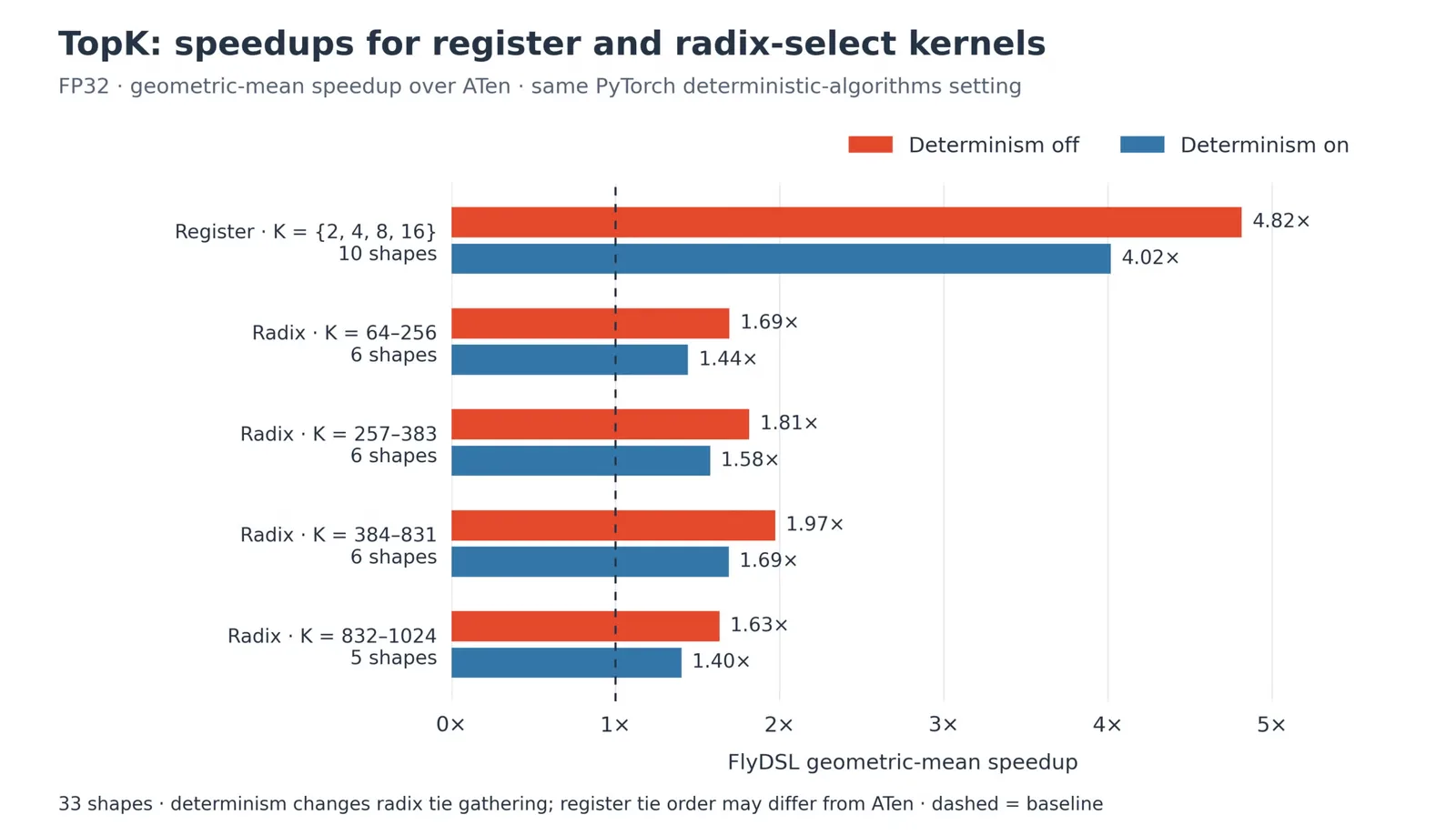
Figure 11. FP32 TopK on MI355X, compared with ATen under the same determinism setting. The bars aggregate all 33 reported cases by kernel family and K band.
The small-K register path shows the largest average gain. The radix-select paths extend the benefit to larger K ranges, although some individual cases are near parity. For applications that inspect indices, equal-value ties can be ordered differently across backends; reproducibility does not guarantee identical tied indices.
Attention: FMHA Kernels Through AOTriton
Unlike the operators above, SDPA does not reach FlyDSL through a PyTorch-side backend. AOTriton compiles FlyDSL kernels into its own library, then dispatches them beside its Triton and AITER ASM kernels. Forward is one kernel; backward uses separate dQ and dK/dV kernels.
For head dimensions up to 256, the forward kernel uses a dual-wave software pipeline. Two KV tiles are in flight per workgroup, and the softmax of one tile runs on the VALU while the other tile’s QK and PV products run on the MFMA units. At head dimension 512, two resident K/V tiles would need about 272 KB of LDS against the 160 KB limit, so a separate wide-head body processes one tile at a time. It splits the head dimension twice: in time, by staging K and V in pipelined D slices through the same LDS buffers, and across waves, with each wave accumulating one slice of the output so the accumulator fits in registers.
Backward reuses the forward building blocks rather than deriving new lane maps. dK/dV is the forward loop transposed: K and V stay in registers while Q and dO stream through LDS, and the transposed operands use the forward’s LDS transpose read (ds_read_b64_tr_b16). In dQ, each of the three GEMMs matches one the forward already emits. The K tile is staged once and read in both orientations, which keeps head dimension 512 within LDS.
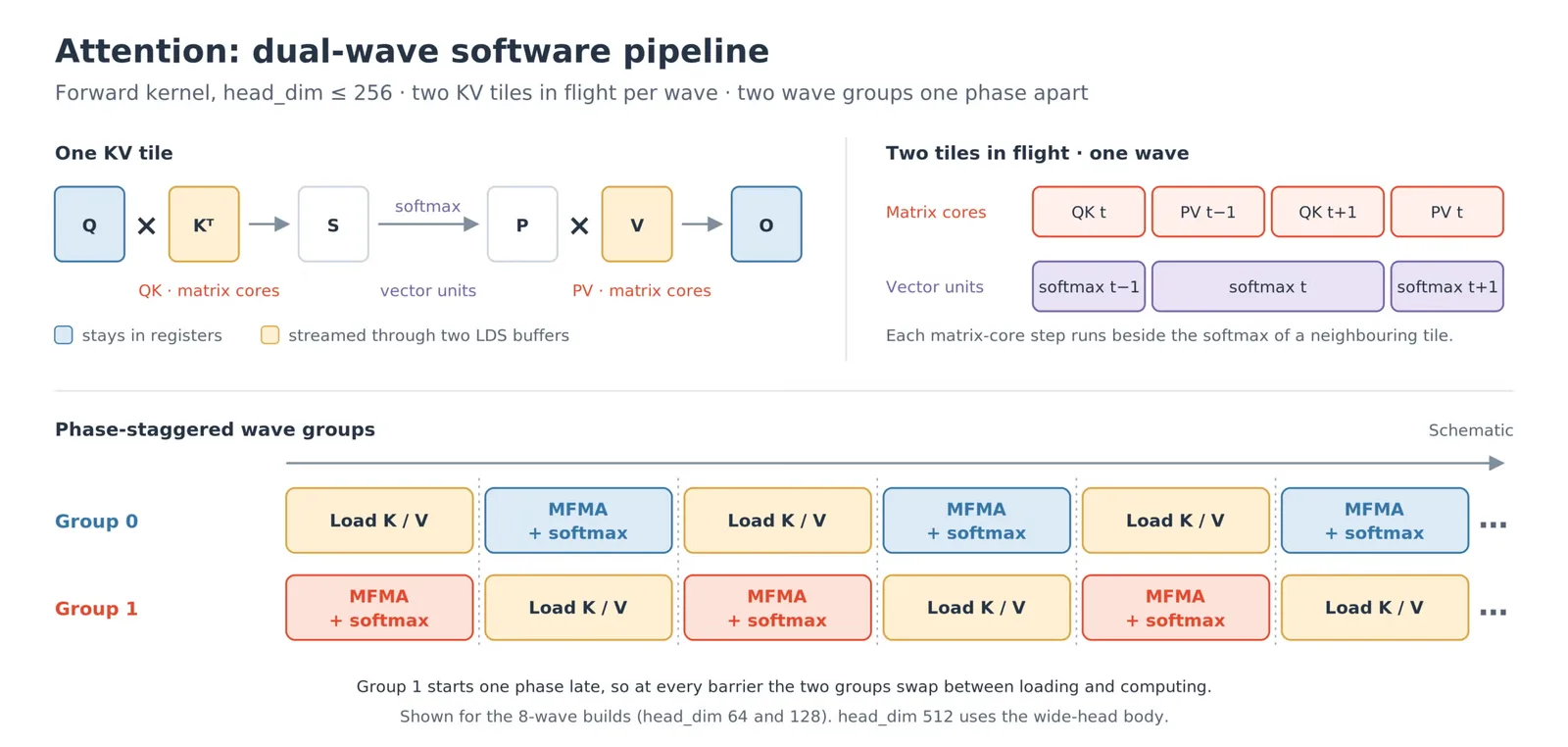
Figure 12. Dual-wave forward pipeline for head dimensions up to 256. Within a wave, each matrix-core step overlaps the softmax of a neighbouring KV tile; across the workgroup, two wave groups run one phase apart, so one group loads K and V while the other computes.
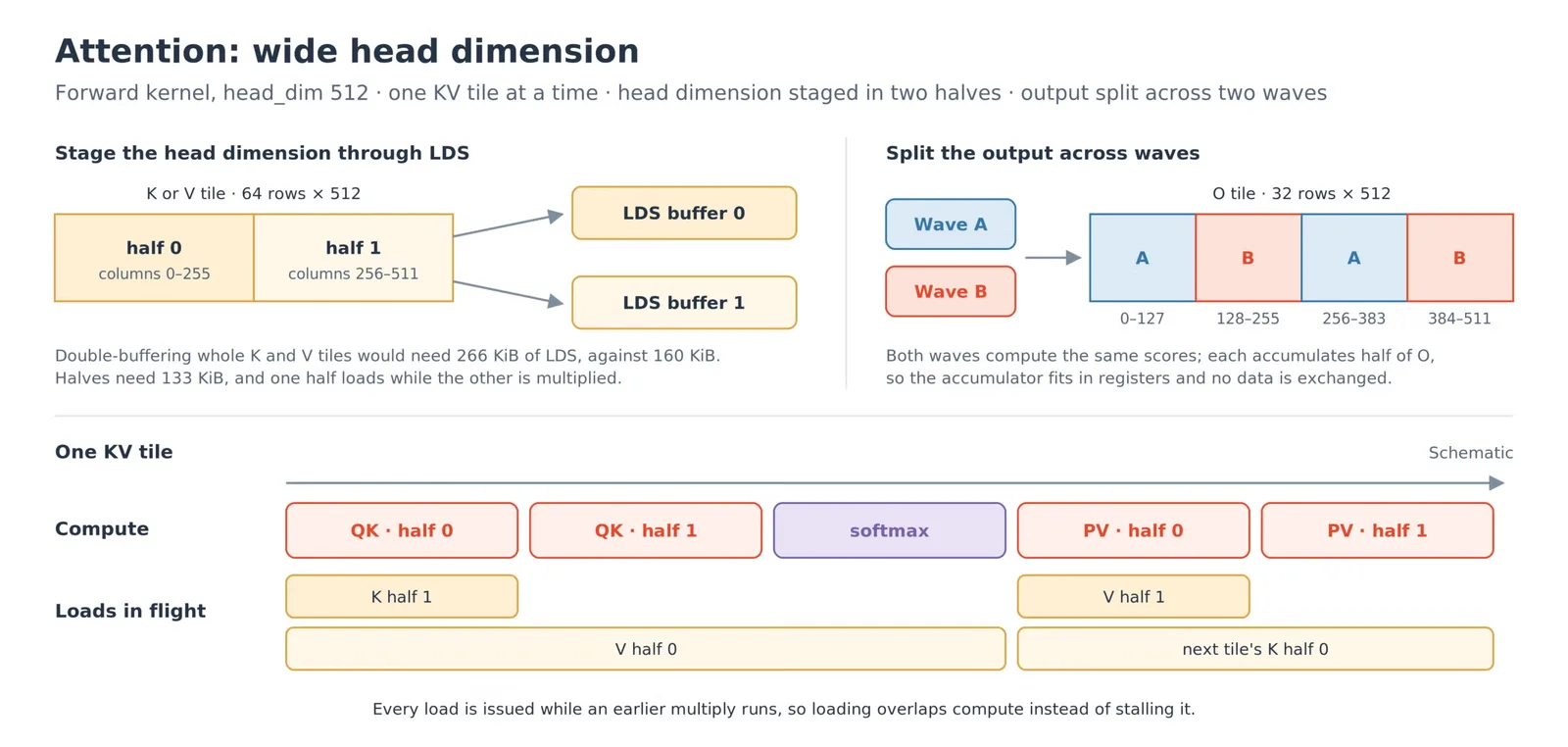
Figure 13. Wide-head forward body at head dimension 512. K and V are staged through two LDS buffers in halves of 256 columns, and two waves compute the same scores while each accumulates half of the output.
The AOTriton 0.14.2b release publishes throughput for AOTriton 0.13b and 0.14.2b by head dimension, direction, and causal mode. For the gfx950 aggregates shown below, forward speedup ranges from 0.92x to 2.34x and backward speedup from 0.93x to 2.47x.
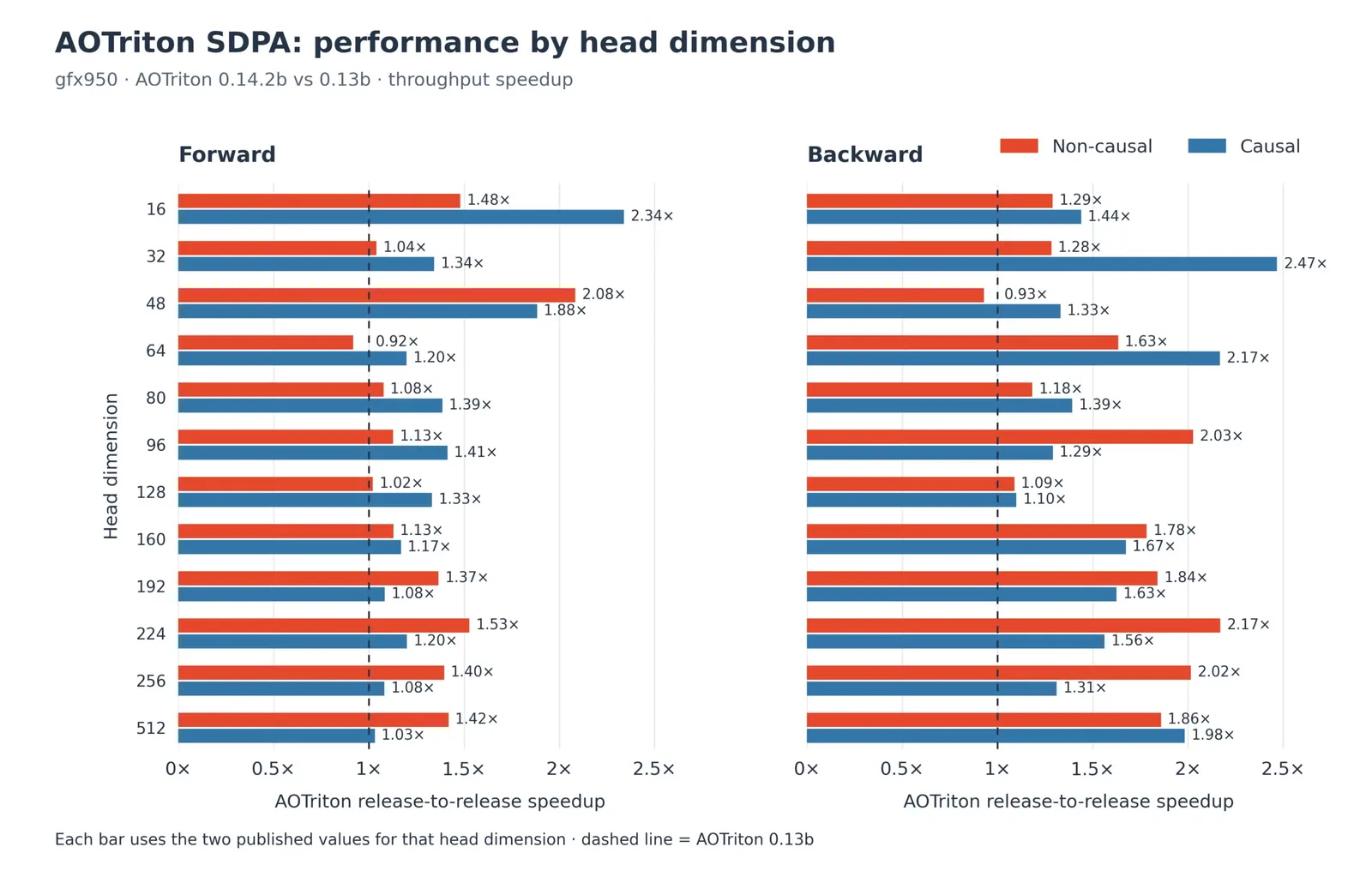
Figure 14. AOTriton 0.14.2b versus 0.13b on gfx950, using the published throughput aggregates for each head dimension. This release-to-release comparison also includes updated Triton, AITER, and tuning databases, so it is not an isolated FlyDSL-versus-Triton measurement.
End-to-End vLLM Inference
We used vllm bench serve on one MI355X (TP=1) with Llama-3.1-8B-Instruct, Qwen3-32B, and Llama-3.3-70B-Instruct. Each request has a 256-token input and fixed 512-token output; concurrency ranges from 8 to 256. The baseline and treatment use the same serving configuration and per-model KV cache, with only the Inductor GEMM candidate list changed. The figure reports whole-request speedup.
BF16. Adding FlyDSL to the ATen/Triton baseline produces the clearest gains for Llama-3.1-8B at low-to-medium concurrency, peaking at 1.13x; Qwen3-32B peaks at 1.06x, while Llama-3.3-70B remains mostly within the 1.79% measured noise floor. The BF16 results report medians from at least two ABBA-interleaved repetitions.
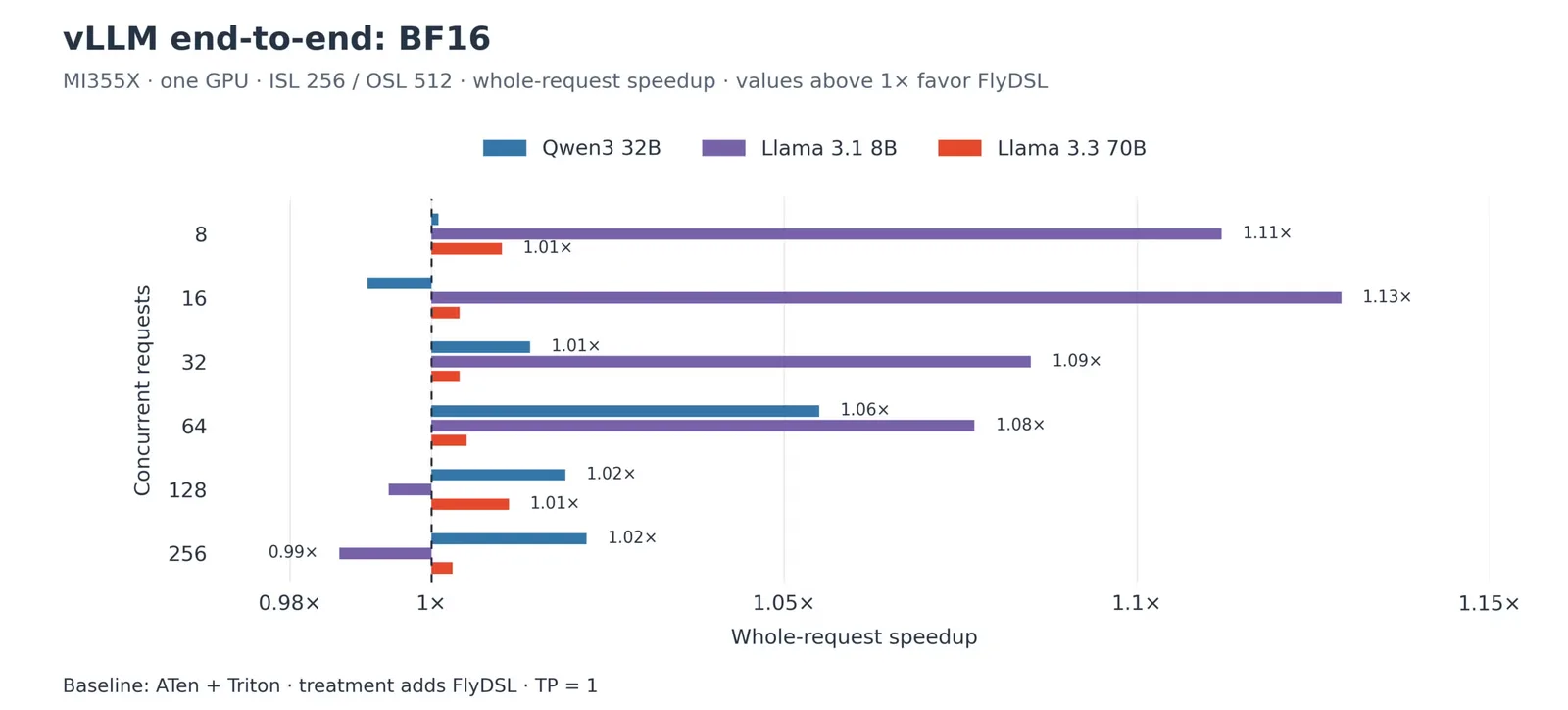
Figure 15. BF16 whole-request speedup on one MI355X. The baseline enables ATen and Triton; the treatment adds FlyDSL. Values above 1x favor FlyDSL.
MXFP8 A8W8. With ATen (hipBLASLt) as the baseline, FlyDSL improves all 18 model-concurrency combinations: 1.40x–2.03x for Qwen3-32B, 1.04x–1.92x for Llama-3.1-8B, and 1.38x–2.04x for Llama-3.3-70B.
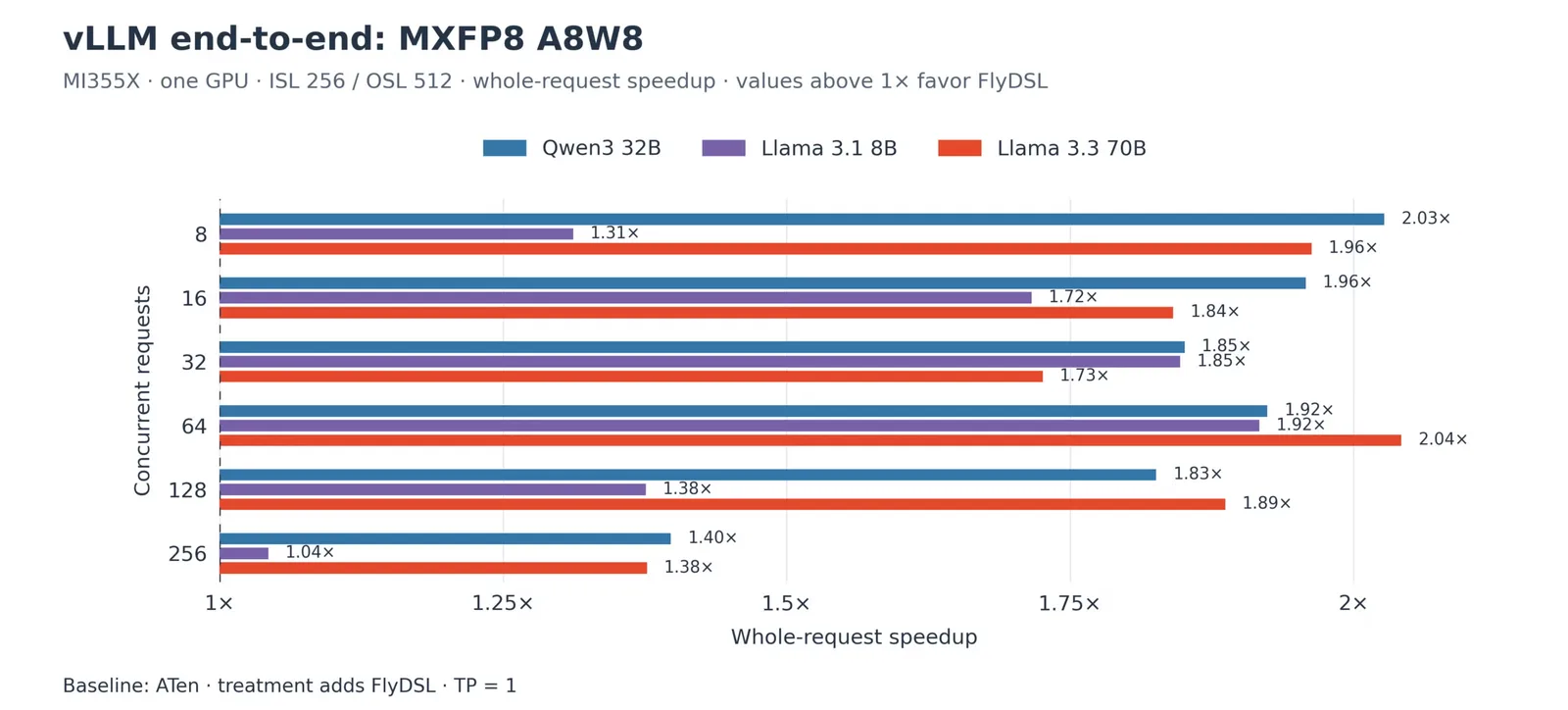
Figure 16. MXFP8 A8W8 whole-request speedup on one MI355X. The baseline is ATen; the treatment adds FlyDSL. Values above 1x favor FlyDSL.
MXFP4 A4W4. With lm_head left unquantized, all 18 combinations also improve: 1.53x–3.01x for Qwen3-32B, 1.25x–1.85x for Llama-3.1-8B, and 1.50x–2.82x for Llama-3.3-70B. MXFP8 and MXFP4 each have one measured run per cell, so small differences should not be treated as variance-qualified results.
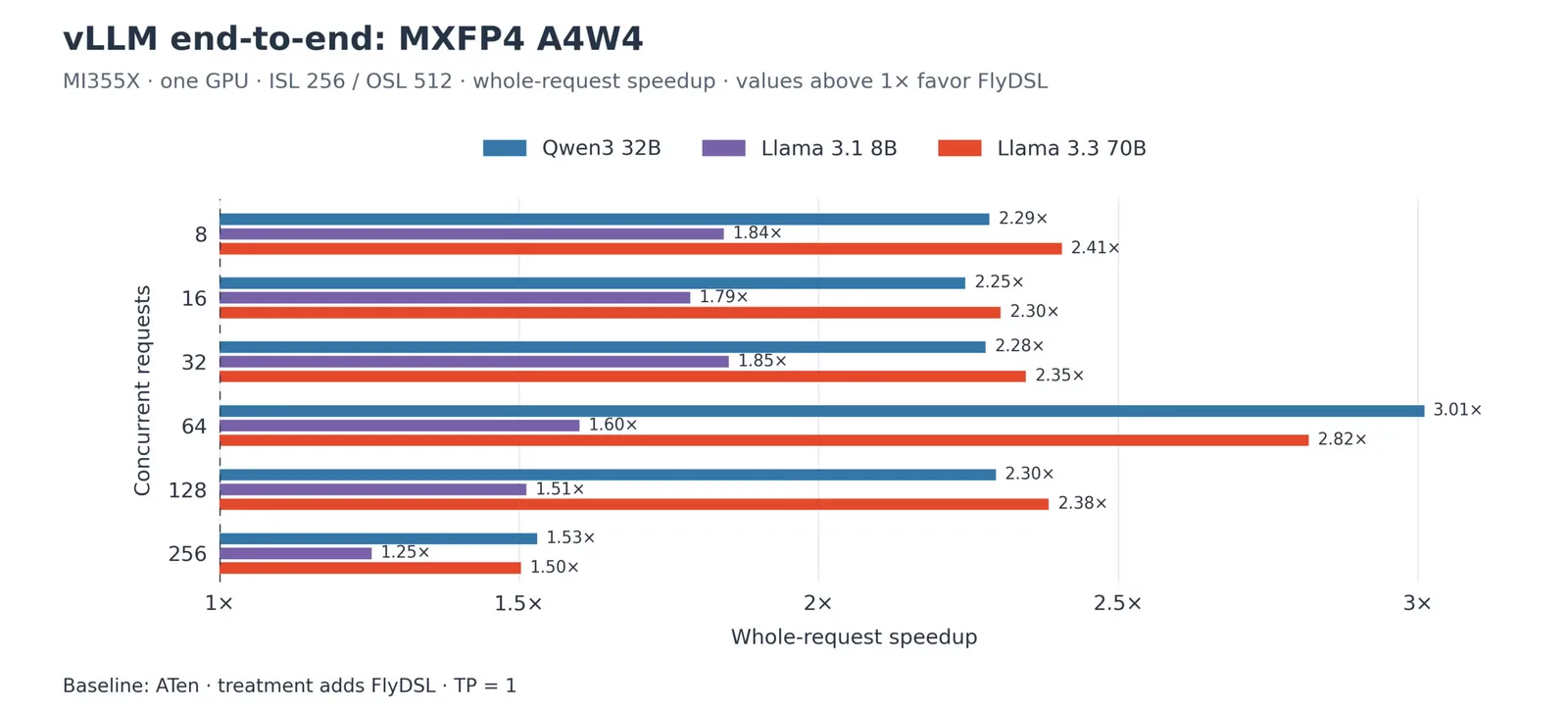
Figure 17. MXFP4 A4W4 whole-request speedup on one MI355X. The baseline is ATen; the treatment adds FlyDSL. Values above 1x favor FlyDSL.
Try It in PyTorch
Use a recent ROCm PyTorch nightly for MI350-series GPUs. This article assumes that it already contains all the FlyDSL integrations described above, including MXFP scaled GEMM. Then install an optional runtime from the supported 0.3.x series:
python -m pip install --upgrade "flydsl>=0.3.0,<0.4"
The examples below require a gfx950 GPU; ROCm builds use PyTorch’s "cuda" device string.
Dense and Grouped GEMM
Enable FlyDSL as a candidate and let torch.compile select the implementation:
import torch
import torch._inductor.config as config

config.max_autotune_gemm_backends = "ATEN,TRITON,FLYDSL"
config.flydsl_enable_autotuning = True

a = torch.randn(128, 4096, device="cuda", dtype=torch.bfloat16)
b = torch.randn(4096, 14336, device="cuda", dtype=torch.bfloat16)

@torch.compile(mode="max-autotune")
def mm(a, b):
    return a @ b

out = mm(a, b)
This example uses NN layout. Eligible transposed inputs enable NT, TN, and TT without another flag. The same settings apply to F.grouped_mm.
The first call includes compilation and tuning; later calls reuse the selected implementation. Enabling FlyDSL gives PyTorch another candidate, so either ATen or Triton may still be selected. Use max-autotune-no-cudagraphs when the workload is incompatible with GPU graph capture. These Inductor configuration controls are version-sensitive and may change between nightly builds.
MXFP8 and MXFP4 Scaled GEMM
With the GEMM configuration above, compile a call on already quantized operands and their block scales. This wrapper uses the public F.scaled_mm API supported by the integration:
import torch.nn.functional as F
from torch.nn.functional import ScalingType, SwizzleType

@torch.compile(mode="max-autotune")
def mxfp_mm(a, b, scale_a, scale_b):
    return F.scaled_mm(
        a,
        b,
        scale_a,
        ScalingType.BlockWise1x32,
        scale_b,
        ScalingType.BlockWise1x32,
        SwizzleType.NO_SWIZZLE,
        SwizzleType.NO_SWIZZLE,
        output_dtype=torch.bfloat16,
    )
For an MXFP8 NT call, pass row-major a[M, K] and column-major b[K, N] with dtype torch.float8_e4m3fn. Both scales have dtype torch.float8_e8m0fnu, with contiguous shapes [M, K // 32] and [N, K // 32]. For MXFP4, use packed torch.float4_e2m1fn_x2 operands with storage shapes [M, K // 2] and [K // 2, N]; the scale shapes use the logical K. The wrapper supports both formats with the same backend settings.
Eager RMSNorm and TopK
Eligible eager calls use FlyDSL automatically. The backend controller makes it easy to compare with ATen:
import torch
import torch.nn.functional as F
import torch.backends.python_native as pn

assert torch.version.hip is not None
assert torch.cuda.get_device_properties(0).gcnArchName.split(":")[0] == "gfx950"
assert pn.flydsl.available

x = torch.randn(8192, 4096, device="cuda", dtype=torch.bfloat16)
weight = torch.ones(4096, device="cuda", dtype=torch.bfloat16)

y = F.rms_norm(x, (4096,), weight, eps=1e-5)
with pn.flydsl.disabled():
    y_aten = F.rms_norm(x, (4096,), weight, eps=1e-5)

torch.testing.assert_close(y, y_aten)
The same pn.flydsl.disabled() context manager applies to eligible torch.topk calls. Actual dispatch depends on the operation’s shape, dtype, and layout.
Attention
SDPA needs no FlyDSL package or configuration. It only needs a PyTorch build linked against AOTriton 0.14.2b or later, which bundles the precompiled kernels:
import torch
import torch.nn.functional as F
from torch.nn.attention import SDPBackend, sdpa_kernel

q, k, v = (torch.randn(4, 16, 4096, 128, device="cuda", dtype=torch.bfloat16,
                       requires_grad=True) for _ in range(3))

with sdpa_kernel(SDPBackend.FLASH_ATTENTION):
    out = F.scaled_dot_product_attention(q, k, v, is_causal=True)
out.sum().backward()
AOTriton chooses FlyDSL or another kernel for each workload.
What’s Next
The next steps extend the range of workloads that can benefit from FlyDSL:
- Broader hardware coverage: extend the PyTorch integration and optimized kernel set to AMD Instinct MI450 Series GPUs.
- More low-precision workloads and attention: add MXFP8 grouped GEMM and FlexAttention kernels for more inference workloads.
- Attention in FlyDSL itself: move the AOTriton attention kernels into FlyDSL’s
kernels/attention/, so AOTriton builds them from upstream instead of a vendored copy. Also add sequence-length-aware attention schedules. - FlexAttention with FlyDSL: add a FlyDSL backend for
torch.nn.attention.flex_attentionundertorch.compile, alongside Inductor’s Triton kernels. - Fusion and training: support GEMM epilogue fusion and broader backward coverage.
- Deployment and validation: add AOTInductor support and expand end-to-end model benchmarks.
These extensions are in progress and are outside the current support and performance results presented here.
Conclusion
The current integration connects FlyDSL kernel development to both eager operators and compiled GEMMs, giving PyTorch users a practical way to benefit from optimized AMD kernels. Through AOTriton, it also reaches F.scaled_dot_product_attention without any user-side changes. The vLLM results show how those kernel choices can translate into model-level gains, particularly for low-precision MXFP8 and MXFP4 workloads. Try it on your workloads and share results or feature requests through the PyTorch issue tracker.
The post Accelerating PyTorch on AMD GPUs with FlyDSL appeared first on PyTorch.
Originally published on
PyTorch Blog
Keep reading

 OpenAI News

 GitHub Engineering