Making every harness durable
Developers are familiar with running coding agents locally through harnesses like Pi, Claude Code, and others. They are reliable daily drivers for generating code, but keeping agents running around the clock requires your computer to be on and awake, which led to the laptop lid memes and Mac mini demand spike.…
Developers are familiar with running coding agents locally through harnesses like Pi, Claude Code, and others. They are reliable daily drivers for generating code, but keeping agents running around the clock requires your computer to be on and awake, which led to the laptop lid memes and Mac mini demand spike.
Running harnesses in the cloud
Harness workloads are moving to the cloud. Individual developers are deploying always-on coding agent workflows, projects like OpenWork and HanaAgent use open-source harnesses as the engines behind the apps, and engineers are building their own harness products.
These harnesses are designed for long-lived processes that keep the session in memory, and agent tasks commonly run for minutes or hours. Locally, a harness has direct, continuous access to the workspace and session history on the same disk, so resuming interrupted work only requires a simple prompt.
In the cloud, you can replicate that setup with a VM and persistent storage, but the VM doesn't automatically record which model and tool calls completed or resume interrupted turns after a crash. A failed turn or network error means lost work.
Also, not every agent task executed through a harness needs a sandbox. Database queries and API calls can run securely in functions, and that also means required credentials never have to enter the sandbox.
Making every harness durable
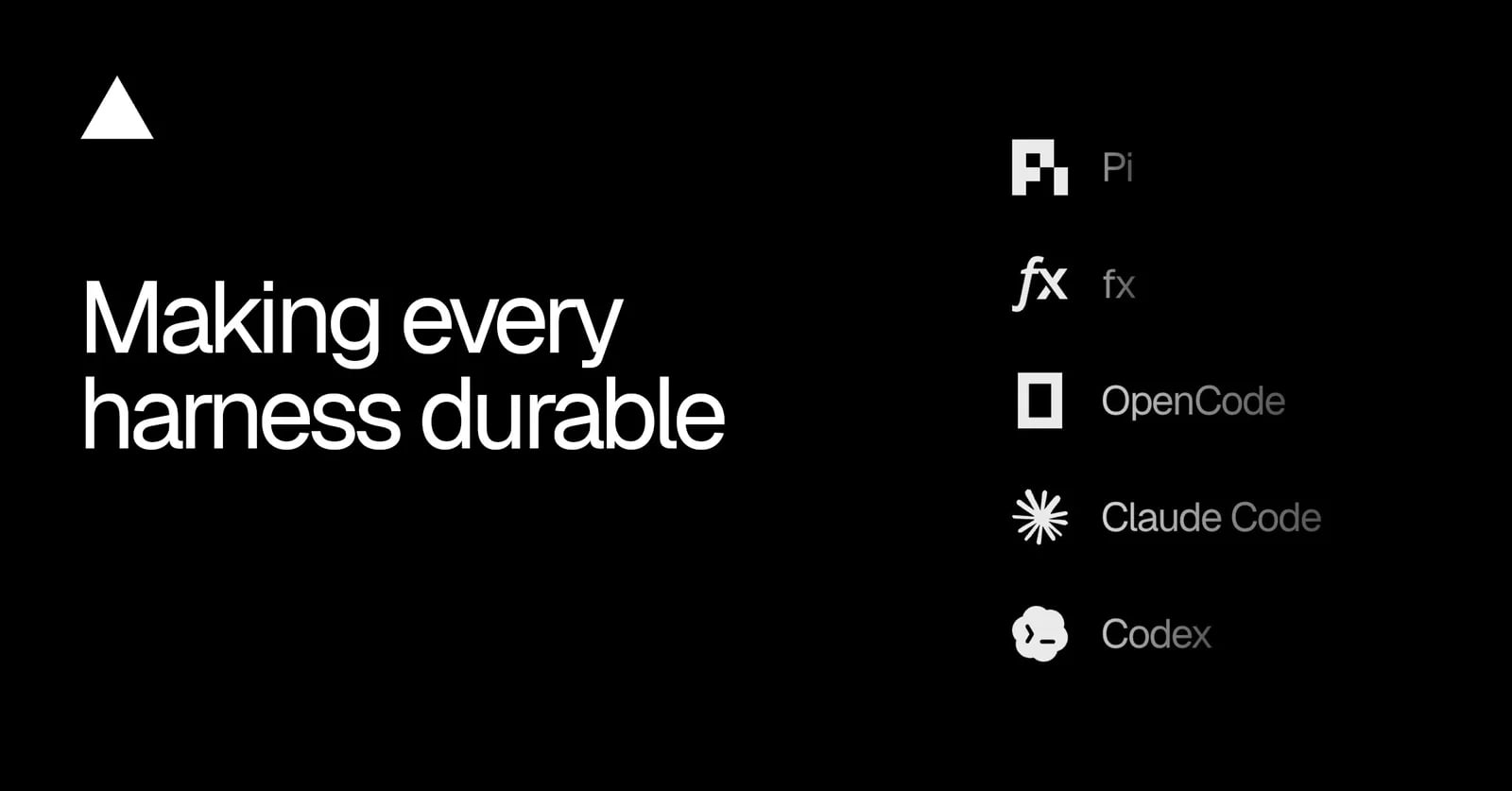
We built eve and fx to run durably in the cloud out of the box, and today we are introducing durable-harness, which extends that durability to any harness, including Pi, OpenCode, Codex, and Claude Code. It uses the same machinery that powers Workflow SDK to survive crashes and function timeouts.
With durable-harness, you can:
- Run any of these harnesses durably on Vercel
- Self-host a harness with your own Postgres instance
- Make your local harness workflow durable
- Build your own durable harness
Sessions that survive a crash mid-turn
Take the example of a coding agent adding a pricing page to an existing app. The agent reads the existing page, writes a new one, opens a pull request, and waits for CI to finish before reporting back.
What happens if its function times out while CI is still running?
Kill the function or drop the connection in the demo below to compare how the two agents recover and which work is repeated.
Without durability, the agent stops work until it is manually restarted, and completed work is repeated unnecessarily.
With durable-harness, a new function reads completed results from the log and resumes the turn. If the browser disconnects, the agent keeps running, and reconnecting catches up from the log.
Logs and queues
durable-harness is the newest package in our open source portfolio. It’s a set of adapters and utilities that let the harnesses you already use keep their sessions in a World, the Workflow SDK’s durable backend.
It writes each step of a turn to a durable log. Before a model call or tool call runs, it records an intent, and when the call finishes, it records the outcome. The turn itself is backstopped with a queue message, so if its function dies, the queue hands the turn to a new function that reads the log and continues where it left off.
After a crash, the log says what finished, what was running, and what never started:
- Completed calls never run again because their results are read from the log, so you’re never billed twice for a finished model call’s tokens.
- Models remember their previous calls rather than repeating them.
- Interrupted tools marked
replay: 'safe'run again. Any other tool comes back to the model as possibly run, and the model decides whether to check.
Harnesses that keep their own session files, like Claude Code's transcript, Codex's rollout, and OpenCode's event store, have every record mirrored into the log, so a new function or Sandbox rebuilds them from it.
Pick your harness
fx and eve are durable on their own. For the rest, durable-harness adds durability from the outside, without changing the harness.
For the full setup guide for each harness, check the docs.
Runs everywhere
Durable agents need a log of each step, a way to resume a turn when its process dies, and a stream for whoever is watching.
Workflow SDK ships all three behind one interface, a World.
durable-harness writes to that interface, so you can move the same agent from one World to another without changing its code:
- On Vercel, it uses the Vercel World.
- In development, it uses files on your machine.
- On your own servers, it uses Postgres, MongoDB, Redis, or Turso.
Two variables move every agent using durable-harness to Postgres.
For more control, such as setting a namespace or recovering sessions when your server starts, create the World in code and pass it to your agent:
Check the self-hosting docs for more details.
See every session in Agent Runs
Agent Runs on Vercel shows the trace for every session, including each model call and tool call. Turns that resumed after a crash appear in the same trace, so you can see exactly where a turn stopped and picked back up.
Tools
An agent has only the tools you give it, and they run in your function. Each tool says what should happen if a crash interrupts it. A 'safe' tool, such as a lookup, can run again. A 'never' tool, such as a refund, never runs twice: the model is told the call may have happened, so it can check before it tries again.
Here’s how the coding agent from the demo above might define its tools:
- A tool that reads a file or checks CI status is marked as
'safe'so it can run again automatically. - A tool that posts a PR comment is marked as
'never'so that comments aren't posted twice.
The following example defines a tool for each policy using the example of an agent processing a refund:
For each harness’s built-in tools, like its shell and file editing, read on.
Files
When a harness needs a shell and files, it’s not safe to run them directly on a shared serverless function host. Many sessions can share the same function, and its filesystem isn’t guaranteed to persist between invocations.
To address this, durable-harness gives you a few options:
virtual()keeps the files in the session’s log, with a bash-compatible shell that can’t reach your function’s files or the network. It suits short tasks and small workspaces without starting an entire sandbox.virtual({ durable: false })keeps the files in memory for scratch work and clears them at the end of every turn.sandbox()gives the session its own Vercel Sandbox, with/workspaceon a Drive that outlives every sandbox and every function. It suits real projects and long-running work.
Compare the three side by side in the docs.
Each harness’s built-in tools run on the workspace you choose. With Pi, CodingTools installs Pi’s own read, write, edit, and bash, and virtualEnv() or sandboxEnv() gives them a workspace:
For OpenCode, pass the workspace as workspace, and for fx, pass it to fxTools(). Claude Code and Codex always run in a Vercel Sandbox, since they expect a real shell and filesystem, and aren’t safe for multi-tenant use. Their built-in tools work on the session’s Drive once you turn them on with builtins: true. Each harness guide lists its built-in tools.
Documents
Some state belongs with the session but isn’t part of the conversation, such as a to-do list, a plan, or a form the agent fills in. A document is typed JSON that lives in the session’s log, so it survives a crash and moves with the session.
Tools can edit documents through io.docs, and each edit commits to the log alongside the tool’s result, so the document’s durable state stays consistent with the tool calls themselves:
Your app can read and edit the same document without a database of its own, and the chat route can even stream every change to your UI:
In fact, the virtual() workspace from earlier is built on documents: its file tree is a document in the session’s log, and each tool call’s changes commit with its result.
Learn more about tools, files, and documents and how to keep your agent secure.
Wrapping up
Developers choose a harness for the choices it makes about prompts, tools, and context. How it survives a crash shouldn’t be one of them. With durable-harness, a turn that loses its function partway through continues from the log on a new one, without a manual retry and without repeating what already finished. Self-hosting and portability work out of the box by building on top of the Workflow SDK’s World interface.
durable-harness is open source on GitHub.

منتشرشده در
Vercel Blog
ادامه مطالعه
 Supabase Blog