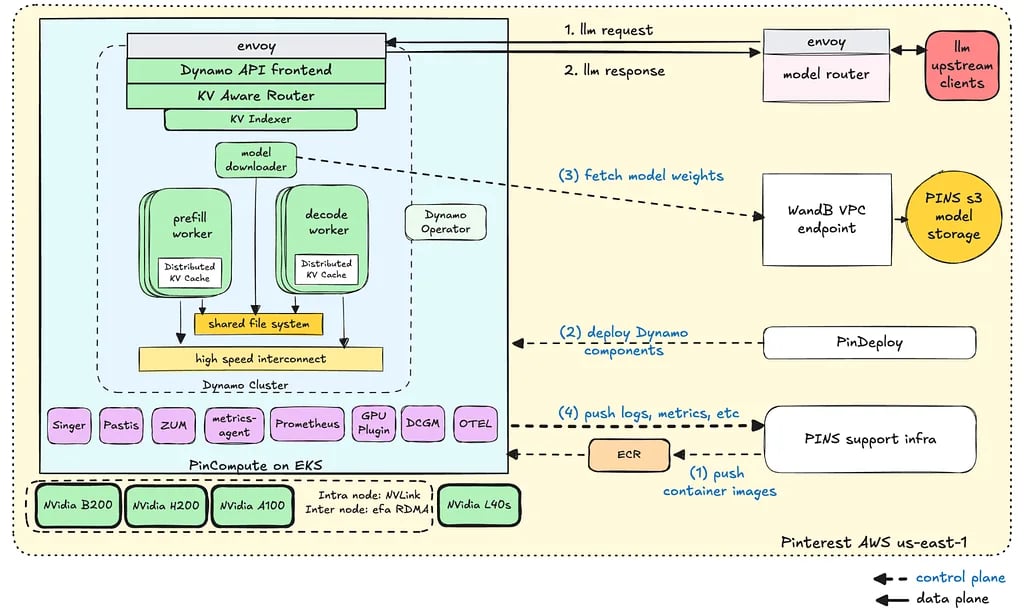
Building Pinterest’s VLM Serving Stack on NVIDIA Dynamo
Lei Pan Senior Software Engineer; Salina Wu Senior Software Engineer; Cristian Lopez Software Engineer I; Guangtong Bai Staff Software Engineer; Soam Acharya Principal Engineer; Saurabh Vishwas Joshi Principal Engineer; Chia Wei Chen Staff Software Engineer; Ambud Sharma Principal Engineer Why VLM Serving Matters at…
Lei Pan | Senior Software Engineer; Salina Wu | Senior Software Engineer; Cristian Lopez | Software Engineer I; Guangtong Bai | Staff Software Engineer; Soam Acharya | Principal Engineer; Saurabh Vishwas Joshi | Principal Engineer; Chia-Wei Chen | Staff Software Engineer; Ambud Sharma | Principal Engineer
Why VLM Serving Matters at Pinterest
Pinterest is a visual search and discovery platform, so its AI systems must reason over both language and visual content. Vision-language models (VLMs), which can interpret images, compare visual candidates, and respond naturally to user intent, are becoming the foundation for the next generation of Pinterest experiences: Pinterest Assistant, hybrid search, multimodal reranking, content understanding, signal generation, content safety, and more.
This direction also reflects Pinterest’s broader strategy to customize open-source models to meet its product & scale needs. Pinterest Assistant is a standout example. This multi-turn conversational experience covers both user language and visual content. Serving it requires low-latency VLM inference over rich multimodal context as well as reworking Qwen3-VL with proprietary multimodal embeddings to cut runtime cost while improving performance.
خواندن Pinterest Engineering با پرو
این منبع جزو کتابخانه پرو است. همه منابع ویژه، ترجمه هوشمند و فیدهای شخصی را باز کنید.
منتشرشده در
Pinterest Engineering
ادامه مطالعه

 Netflix TechBlog