App hosting platforms with managed Postgres compared (2026): Node.js on Prisma Compute, Railway, Render, Fly.io, Vercel
Prisma Compute, Railway, Render, Fly.io, Supabase, Neon and Vercel compared for an app next to managed Postgres: previews, idle cost, pooling, backups and prices.
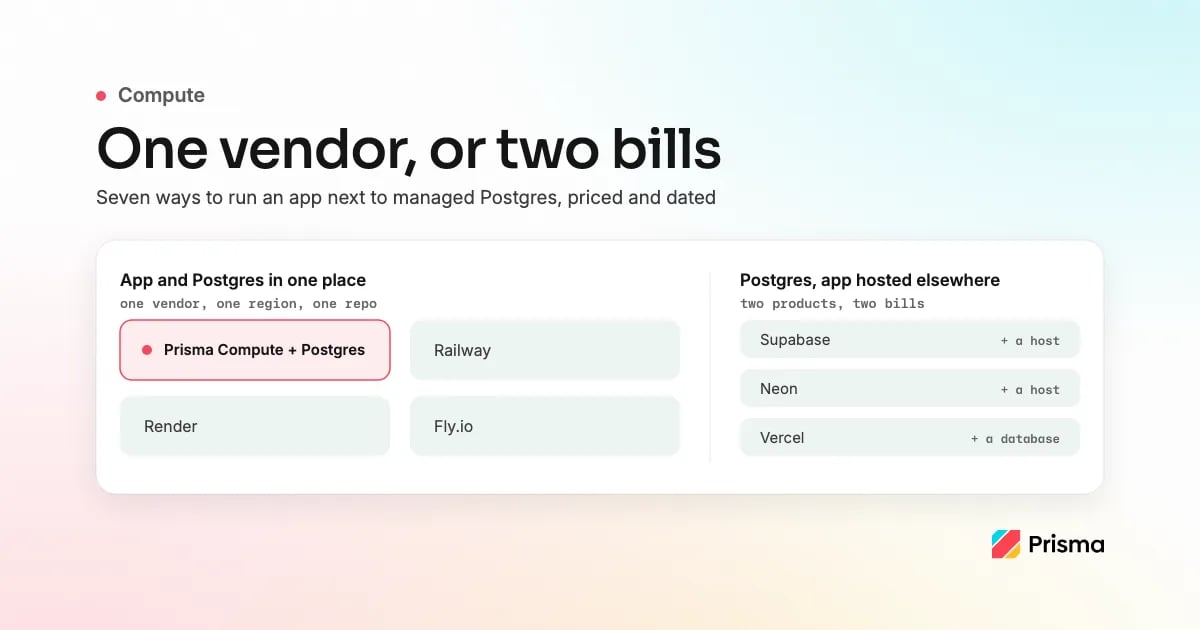
App hosting platforms with managed Postgres compared (2026): Prisma Compute, Railway, Render, Fly.io, Supabase, Neon and Vercel
Seven ways to run an app next to a managed Postgres database in 2026, compared on previews per branch, idle cost, pooling, backups and price at small scale, with every competitor number linked to the vendor page and dated. Prisma Compute and Prisma Postgres are our product, and the rows say where they are the wrong pick.

Gregory BochSeptember 30, 2026Updated October 14, 2026
Five platforms host a Node.js app next to managed Postgres in 2026: Prisma Compute with Prisma Postgres, Railway, Render, Fly.io, and Vercel with a Marketplace database (Prisma Postgres, Neon or Supabase); Supabase and Neon run the database with functions beside it. They differ on who runs the database, what an idle app costs, previews per branch and runtime limits. Prisma Compute runs TypeScript apps built for Node.js, Bun or Next.js on Bun, next to Prisma Postgres in one project and region. Prisma makes Prisma ORM, Prisma Postgres and Prisma Compute.
We make Prisma Compute and Prisma Postgres. The comparison table and the platform sections are in alphabetical order, and the criteria are the columns of the Quick comparison table. The Prisma cells come from Prisma's docs and pricing page; every other cell was checked against the vendor's own pricing page or docs on 29 September 2026, the Railway, Neon, point-in-time recovery and Postgres extension cells again on 8 October 2026, the Fly.io and Neon price cells and the Fly.io project cell on 12 October 2026, and the Railway price and backups cells and the Neon Functions Free allowance on 14 October 2026, listed under Sources and check dates. Where a vendor page states no number, the cell says so.
Quick recommendation
A TypeScript service and its database from one GitHub repository in one project: Prisma Compute and Prisma Postgres. The Free plan has no usage billing; Starter is a $10 base, and Compute memory, CPU and bandwidth are metered on top. A WebSocket server or a Python or Go API: Render or Fly.io run the container you have next to a managed database, Railway runs it next to a Postgres template Railway maintains, and Fly.io runs it in more than one region. Point-in-time recovery today: Neon, Railway (opt-in), Render (paid databases), Fly Managed Postgres or Supabase (paid add-on), because Prisma Postgres does not have it yet.
| Your situation | Pick | Why |
|---|---|---|
| I just want it deployed from GitHub, everything in one project | Prisma Compute + Prisma Postgres | App and database in one project. Add a Prisma Composer declaration and make two changes to each Node.js or Bun server, three if it talks to Postgres, run your build, deploy with npx prisma deploy module.ts (it does not build for you), then connect the repo and add the prisma/cloud-deploy-action workflow for deploy on push |
| Small production app with previews per branch | Prisma Compute + Prisma Postgres | Starter $10 base, 5M requests and 1M operations included. Once deploy on push is set up, every pushed branch gets a preview with its own services and, for databases declared in the Composer module, its own new database; production data is not copied |
| REST, tRPC or GraphQL API + TypeScript frontend + Postgres from GitHub | Prisma Compute + Prisma Postgres | One project, one region, PgBouncer pooling included |
| Leaving Netlify with a full-stack TypeScript app and Postgres | Prisma Compute + Prisma Postgres | The frontend, the API and the database deploy from one repository; Netlify alternatives for a full-stack TypeScript app has the feature-parity table |
| Just hosted Postgres, free, standard tools | Prisma Postgres | PostgreSQL 17, 2 GB and 200,000 operations a month on Free, any Postgres client |
| Holds WebSocket connections open | Fly.io, Neon Functions, Railway, Render | Prisma Compute does not run WebSocket servers |
| Python or Go API | Railway, Render, Fly.io | Prisma Compute runs TypeScript on Bun |
| More than one region | Fly.io | One region per Prisma Compute service, from six |
| Need point-in-time recovery today | Neon, Railway (opt-in), Render (paid databases), Fly Managed Postgres, Supabase (paid add-on) | Prisma Postgres has daily snapshots on paid plans, no PITR yet |
| Frontend needs a global CDN above all | Vercel + Prisma Postgres, or another Marketplace database | Prisma Compute is not a CDN or edge platform |
| Lowest bill, and you run servers yourself | A VPS | Every managed option here charges for the management |
Quick comparison
Rows in alphabetical order; we make Prisma Compute and Prisma Postgres.
| App + DB in one project | Preview / staging per branch | Idle cost | Same-region networking | Pooling | Backups / PITR | Postgres extensions | Price at small scale | Exit path | |
|---|---|---|---|---|---|---|---|---|---|
| Fly.io | In one organization: Managed Postgres runs in the organization's private network and is attached to an app | Per pull request via GitHub Actions; no database in the guide | Autostop; no CPU or RAM charge while stopped | Per organization | Included | Automated backups; point-in-time restore with fly mpg restore --pitr-time | pgvector; PostGIS if enabled at provisioning | $2.19 Machine + $38 Managed Postgres a month, plus $0.28 per GB of database storage (Fly.io pricing, as of October 2026) | pg_dump |
| Neon | Backend functions next to the database (Neon Functions, four AWS regions); UI on another host | Copy-on-write branch with the parent's data | Scales to zero after 5 minutes; no base fee | Functions in the database's region; UI depends on its host | PgBouncer, -pooler string | Instant restore on every plan, window set by plan | pgvector, PostGIS, TimescaleDB (Apache-2 features) and more | Free $0; Launch $0.106 per CU-hour for the database; Functions billed separately on paid plans (on Launch: $0.10 active and $0.025 waiting per Capacity-Hour, $0.60 per million invocations); plus your UI host (Neon pricing and plans, as of October 2026) | pg_dump |
| Prisma Compute + Prisma Postgres | Yes; TypeScript on Bun, no WebSocket servers | Per pushed branch once deploy on push is set up: its own services and a new database for each one the module declares; production data not copied | App scales to zero; database per operation | One of six regions per service | PgBouncer included | Daily snapshots on paid plans, 7 or 30 days; no PITR | pgvector, pg_search, pg_trgm and other standard extensions; no PostGIS or TimescaleDB | Free: app and database, no usage billing. Starter $10 base, 5M requests and 1M operations included, memory, active vCPU and bandwidth metered (Prisma pricing, as of September 2026) | pg_dump; the Composer module is a TypeScript file in your repo, not a runtime |
| Railway | Yes, a Postgres template Railway maintains; backups, PITR, HA and pooling opt-in | Per pull request | Sleeps 5 to 10 minutes after last outbound traffic with Serverless enabled; otherwise runs all month | Per environment | PgBouncer add-on you enable on the Postgres service | Volume backups by hand or on a schedule you turn on; opt-in PITR for Postgres, about 4 weeks | None added to the default template; pgvector, PostGIS and TimescaleDB as separate templates | Free $0 with $1 of credit a month after a 30-day trial; Hobby $5 with $5 of usage, then $10 per GB RAM and $20 per vCPU a month (Railway pricing and plan reference, as of October 2026) | pg_dump |
| Render | Yes, managed | Per pull request on the Pro workspace ($25 a month); no data copied | Free spins down after 15 minutes; paid runs all month | Per region | PgBouncer on paid databases | PITR on paid databases, 3 or 7 days | pgvector, PostGIS, TimescaleDB (no Community features) and more | $7 web service + $6 Postgres a month (Render pricing, as of September 2026) | pg_dump |
| Supabase | Backend only (Edge Functions) | Per pull request; no production data by default | Free pauses after a week idle; paid runs all month | Depends on your app host | Shared pooler; dedicated on paid plans | Daily, 7 days on Pro; PITR add-on $100 a month | Over 50 preconfigured, including pgvector and PostGIS | Free $0; Pro from $25 a month, plus your app host (Supabase pricing, as of September 2026) | pg_dump |
| Vercel + Marketplace database | No; Marketplace database | Preview per push; a database per preview depends on the integration | Functions per use; database on its own plan | Depends on the database region | From the provider | From the provider | From the provider | Hobby $0; Pro $20 a month plus the database plan (Vercel pricing, as of September 2026) | pg_dump |
The seven platforms, A to Z
Each entry has the same headings, and each competitor ends with how it compares with Prisma Compute + Prisma Postgres. We make Prisma Compute and Prisma Postgres; the other six were checked against their own docs on 29 September 2026, and the details that later updates changed were checked again on 8, 12 and 14 October 2026.
Fly.io
Best for: an app in more than one region, or one that holds WebSocket connections open, with Managed Postgres in the same organization.
What it does: runs Machines in 17 regions, most of which also host Fly Managed Postgres, with backups and pooling on every database plan. A Managed Postgres cluster runs in the organization's private network, and attaching it to an app sets the connection string as a secret on that app.
Scaling behavior: Machines autostop when idle and autostart on request; a stopped Machine pays only for its root filesystem.
Pricing: a shared-cpu-1x 256 MB Machine at $2.19 a month plus Managed Postgres Basic at $38 and database storage at $0.28 per GB, Machines billed by the second. Fly.io pricing, as of October 2026.
Trade-offs: Managed Postgres plans start at $38 a month, and the review-apps guide creates an app per pull request but no database. Managed Postgres restores to a point in time with fly mpg restore --pitr-time.
Compare: Fly.io vs Prisma Compute.
vs Prisma Compute + Prisma Postgres: Fly.io runs Machines in more than one region, holds WebSocket connections open and runs any language, and its Managed Postgres includes high availability and pooling on every plan plus point-in-time restore; Prisma Compute + Prisma Postgres starts on a Free plan for the app and the database, where Fly Managed Postgres starts at $38 a month, and gives every pushed branch a preview with a new database for each one the Composer module declares, where Fly's review-apps guide creates no database.
Neon, plus a host for the frontend
Best for: branches with production-shaped data per pull request, point-in-time restore, and no monthly floor.
What it does: serverless Postgres billed by the CU-hour (its pricing page now calls it Lakebase Postgres). Neon Functions (generally available since 2026-09-17, also on Free) run Node.js 24 HTTP handlers next to the database, including WebSockets and SSE, in four AWS regions today; Neon's full-stack guide keeps the UI on Vercel, Netlify or another frontend host.
Scaling behavior: compute scales to zero after 5 idle minutes, up to 16 CU on Launch; an always-on API pays for every hour awake.
Pricing: Free $0 with 100 CU-hours and 1 GB of storage per project, up to 20 GB across all projects; Launch $0.106 per CU-hour and $0.35 per GB-month with restore up to 7 days; Scale $0.222 per CU-hour with up to 30 days. Functions are billed separately: on Launch, $0.10 per active and $0.025 per waiting Capacity-Hour plus $0.60 per million invocations, and Free includes 10 active and 400 waiting Capacity-Hours and 1 million invocations per project a month. Neon pricing and plans, as of October 2026.
Trade-offs: the frontend needs a second host, and extra branches ($1.50 per branch-month) and restore history ($0.20 per GB-month) add up.
Compare: Neon vs Prisma Postgres for app hosting in one place and the pricing comparison.
vs Prisma Compute + Prisma Postgres: Neon has point-in-time restore on every plan, copy-on-write branches with the parent's data, and Functions that hold WebSocket connections and run on cron triggers; Prisma Compute also runs the server that serves the frontend, so a web app and its database run in one project and region, and Prisma Postgres bills per operation instead of by compute hours.
Prisma Compute + Prisma Postgres
Best for: a TypeScript frontend and Node API deployed from one GitHub repository next to their database, in one project.
What it does: Prisma Compute, generally available since August 2026, runs TypeScript HTTP services (Node.js, Bun or Next.js) next to Prisma Postgres. With Prisma Composer you describe your whole app in TypeScript:
npx prisma dev module.ts
runs it on your laptop, and
npx prisma deploy module.ts
provisions the services on Prisma Compute and the databases on Prisma Postgres, applying the committed migrations to any database declared with
postgres()
and a Prisma ORM contract before its service starts. An existing repository adds a declaration (a
service.ts
per server plus one
module.ts
) and makes two changes to each Node.js or Bun server, three if it talks to Postgres: read the port from
service.port()
and bind 0.0.0.0, turn other
process.env
reads into service inputs or dependencies, and, in a server that talks to Postgres, build the client from the injected
db.url
. A Next.js app uses the
nextjs
build adapter with
output: 'standalone'
instead, and its standalone server binds the port itself. A coding agent can do this from the porting guide prompt.
Scaling behavior: the app scales to zero when idle; the database bills per operation.
Pricing: Free $0 for app and database, no usage billing, no credit card. Starter $10 base with 5M requests and 1M operations included; memory ($0.006 per GB-hour), active vCPU ($0.064 per vCPU-hour) and bandwidth ($0.025 per GB) metered from the first unit. Prisma pricing, as of September 2026.
Trade-offs: Railway, Render, Fly.io and Neon Functions run WebSocket servers; Prisma Compute does not. One region per service from six, a Bun runtime, 60 seconds to send the first byte, daily snapshots on paid plans only, and no point-in-time recovery yet. Composer limitations lists what the declaration does not cover.
Compare: Where to host a TypeScript frontend, Node API and Postgres, and for a move off Netlify, Netlify alternatives for a full-stack TypeScript app with Postgres.
Railway
Best for: the container you have, in any language, next to Postgres, with an environment per pull request.
What it does: builds your repository into a long-lived service, with Postgres as a template service in the same project on the environment's private network, PgBouncer as an add-on, and point-in-time recovery for Postgres (about 4 weeks).
Scaling behavior: with the Serverless setting enabled, a service sleeps 5 to 10 minutes after its last outbound traffic and wakes on the next request.
Pricing: a Free plan for one project after a 30-day trial ($0 with $1 of credit a month in the plan reference; $1 a month on the pricing card); Hobby $5 a month with $5 of usage included, then $10 per GB of RAM and $20 per vCPU a month. Railway pricing and plan reference, as of October 2026.
Trade-offs: Railway maintains its Postgres template; backups, point-in-time recovery, high availability and PgBouncer pooling are opt-in in its docs (checked 2026-10-08). Sleeping is opt-in per service: without the Serverless setting, a service runs and bills RAM and vCPU all month.
Compare: Railway vs Prisma Compute.
vs Prisma Compute + Prisma Postgres: Railway builds the repository in any language Railpack supports, or from its Dockerfile, holds WebSocket connections open and offers the opt-in Postgres features above; Prisma Compute needs a Prisma Composer declaration and two changes to each Node.js or Bun server, three if it talks to Postgres, and in return gives every pushed branch, not only pull requests, a preview with its own services and a new database for each one the Composer module declares, and scales an idle app to zero without a setting.
Render
Best for: managed Postgres with point-in-time recovery next to a container you keep as it is.
What it does: builds from GitHub and runs web services next to managed Postgres in one region. Hobby workspaces get single-service previews; a full preview environment per pull request, copied without its data, needs the Pro workspace.
Scaling behavior: Free web services spin down after 15 idle minutes; paid instances run all month at a fixed price.
Pricing: the smallest paid web service (512 MB) is $7 a month and the smallest paid Postgres (256 MB) is $6; the Pro workspace adds $25 a month, and Free Postgres databases expire after 30 days. Render pricing, as of September 2026.
Trade-offs: pooling and PITR need a paid database, and PITR keeps 3 days on Hobby and 7 on Pro.
Compare: Render vs Prisma Compute.
vs Prisma Compute + Prisma Postgres: Render runs WebSocket servers and APIs in any language next to managed Postgres, with point-in-time recovery on paid databases; Prisma's Free plan has no time limit, where Render's free Postgres expires after 30 days, and Prisma Compute scales an idle app to zero on every plan and gives every pushed branch a preview with a new database for each one the Composer module declares, where Render's full preview environments need the Pro workspace.
Supabase, plus a host for the app
Best for: Postgres with auth, storage and Edge Functions from one vendor, with the frontend elsewhere.
What it does: managed Postgres with a shared pooler and Edge Functions on Deno; it does not host frontends. A branch per pull request starts without production data; a seed file fills it.
Scaling behavior: paid compute runs all month at the size you pick; branches bill $0.01344 per branch-hour; Free projects pause after a week of inactivity.
Pricing: Free $0 with 500 MB and no backups; Pro from $25 a month with daily backups kept 7 days; the PITR add-on is $100 a month per 7 days of retention and needs at least Small compute. Supabase pricing, as of September 2026.
Trade-offs: two bills, and the direct connection is IPv6 unless you buy the IPv4 add-on.
Compare: Switch from Supabase to Prisma Postgres.
vs Prisma Compute + Prisma Postgres: Supabase bundles auth, storage and Edge Functions with Postgres and sells point-in-time recovery as an add-on; Prisma Compute also runs the app server and the API, so the app and Prisma Postgres run in one project from one vendor, and Prisma's Free plan includes 2 GB of storage.
Vercel, plus a Marketplace database
Best for: a frontend that needs a global CDN above everything else.
What it does: builds the frontend and its functions from Git with a preview deployment per push to a non-production branch. Vercel Postgres is no longer available (existing databases moved to Neon in December 2024); Postgres comes from the Marketplace, where Neon, Supabase and Prisma Postgres are providers.
Scaling behavior: Fluid compute bills active CPU and provisioned memory per use; the database bills on the provider's plan.
Pricing: Hobby $0; Pro $20 a month with $20 of usage credit and one developer seat, active CPU from $0.128 per hour, plus the database plan. Vercel pricing, as of September 2026.
Trade-offs: two products, two bills, and a database per preview depends on the integration.
Compare: Prisma vs Vercel and Prisma Compute vs Vercel pricing.
vs Prisma Compute + Prisma Postgres: Vercel serves the frontend from a global CDN with a preview deployment per push, and lets you pick the database from the Marketplace, Prisma Postgres included; Prisma Compute runs a frontend served by Next.js, Astro, TanStack Start or your own Node.js or Bun server, and the API, next to Prisma Postgres in one project and region, and every pushed branch gets a preview with a new database for each one the Composer module declares, instead of depending on the integration.
Platforms with app hosting and Postgres in one place
Four of the seven host the app and the database with one vendor: Prisma Compute with Prisma Postgres, Railway and Render in one project, and Fly.io in one organization, where a Managed Postgres cluster runs in the organization's private network and is attached to an app. On Railway, Render and Fly.io the database is a resource next to the app, read from a connection string. On Prisma it is a dependency the service declares in its Composer module: the deploy provisions it and hands the service the connection, typed and migrated before the service starts when declared with
postgres()
and a Prisma ORM contract, a plain URL you migrate yourself when declared with
rawPostgres()
. The cost is a declaration in the repo and a TypeScript-only runtime; the return is that production and every preview branch get the same wiring.
Supabase and Neon run backend code next to the data. Supabase does not host frontends, and Neon's full-stack guide keeps the UI on Vercel, Netlify or another frontend host, so a web app on either has two hosts and two bills. Vercel is the app host, with the database from a Marketplace provider.
Considering Neon but want app hosting too?
Neon Functions (generally available since 2026-09-17, also on Free) run Node.js 24 HTTP handlers next to the database, including WebSockets and SSE; Neon's full-stack guide keeps the UI on Vercel, Netlify or another frontend host (neon.com, checked 2026-10-08). Functions are available today for Neon projects in four AWS regions. To keep the frontend, the API and Postgres with one vendor instead, Prisma Compute with Prisma Postgres, Railway, Render and Fly.io each host all three. Neon alternatives with app hosting and Postgres in one place compares Neon with Prisma Compute and Prisma Postgres, Railway, Render and Supabase.
Managed Postgres hosting options that scale
Four things decide whether the database keeps up when traffic grows.
- Connection pooling. Prisma Postgres, Neon and Fly Managed Postgres include a pooler; Render has one on paid databases; Supabase has a shared pooler, dedicated on paid plans; Railway adds PgBouncer when you enable it.
- Backups and point-in-time recovery. A daily snapshot restores last night; PITR restores the minute before the bad migration. Neon, Railway (opt-in, about 4 weeks), Render (paid databases), Fly Managed Postgres and Supabase (paid add-on) have PITR. Prisma Postgres keeps daily snapshots for 7 or 30 days on paid plans and has no PITR yet.
- Migrations. On Prisma, a
postgres()database with a Prisma ORM contract gets its committed migrations applied before the service starts; arawPostgres()database is yours to migrate. Elsewhere, a release command or CI step runs them over the direct connection string. - Spend limits. Prisma's paid plans include a spend limit; on the others, find the usage alert or hard limit before you add a card.
Where Prisma is the wrong choice
- Your API holds WebSocket connections open. Fly.io, Railway, Render and Neon Functions run those; Prisma Compute does not.
- You are not writing TypeScript. Prisma Compute runs TypeScript on Bun; a Python or Go API belongs on Railway, Render, Fly.io or a VPS.
- You need more than one region, or point-in-time recovery today. Each Prisma Compute service runs in one of six regions, and Prisma Postgres has no PITR yet.
- You want the repository deployed with no declaration. Railway, Render and Fly.io build the code as it is; Prisma needs a Composer declaration and two changes to each Node.js or Bun server, three if it talks to Postgres.
- Your frontend's main requirement is a global CDN. Put it on Vercel with Prisma Postgres or another Marketplace database.
The full list of limits lives in one place, Where it has trade-offs in the Prisma Compute FAQ.
Frequently asked questions
Can I host my existing GitHub repo on Prisma Compute?
Yes, once the repository carries a Composer declaration: a
service.ts
for each server and a
module.ts
that composes them, plus two changes to each Node.js or Bun server, and a third if it talks to Postgres. A Node.js or Bun server reads its port from
service.port()
and binds 0.0.0.0, and its other
process.env
reads become service inputs or dependencies; a server that talks to Postgres declares a
rawPostgres()
dependency and builds its client from the injected
db.url
. A Next.js app instead uses the
nextjs
build adapter with
output: 'standalone'
, whose standalone server binds the port itself. A coding agent can make these changes from the porting guide prompt. Run your build, then deploy with
npx prisma deploy module.ts
, which packages the build output and does not build for you. For deploy on push, connect the repository and add the
prisma/cloud-deploy-action
workflow; a connected repository without the workflow deploys nothing.
Do I need Prisma ORM to use Prisma Compute or Prisma Postgres?
No: Prisma Postgres runs PostgreSQL 17 and any Postgres client works, whether
pg
, Drizzle, Kysely,
psql
or Prisma ORM. Prisma Compute pairs with Prisma ORM for the typed database client but does not require it.
Which managed Postgres options have point-in-time recovery?
Neon (every plan), Railway (opt-in), Render (paid databases), Fly Managed Postgres (
fly mpg restore --pitr-time
) and Supabase (add-on) have point-in-time recovery. Prisma Postgres does not yet and restores from daily snapshots on paid plans.
Sources and check dates
| Vendor | Pages | Checked |
|---|---|---|
| Prisma | Pricing, Compute pricing, Compute limitations, Deploy on push, Port an existing app, Service input, Composer databases, Backups, Connection pooling, Postgres extensions | 2026-09-29; pricing, deploy on push and extensions 2026-10-08; porting guide 2026-10-08 and 2026-10-12; service input 2026-10-12 |
| Railway | Pricing, Plan reference, Environments, Backups, Point-in-time recovery, Serverless, PostgreSQL template, What Railway manages, Connection pooling, Private networking | 2026-09-29; PostgreSQL template, What Railway manages, point-in-time recovery and pricing 2026-10-08; pricing, plan reference, Backups and What Railway manages 2026-10-14 |
| Render | Pricing, Preview environments, Postgres backups, Connection pooling, Free instances, Private network, Postgres extensions | 2026-09-29; Free instances, Postgres backups and extensions 2026-10-08 |
| Fly.io | Pricing, Managed Postgres, Attach an app, mpg restore, Autostop and autostart, Regions, Review apps, Private networking | 2026-09-29; Managed Postgres and mpg restore 2026-10-08; pricing, Managed Postgres and Attach an app 2026-10-12 |
| Supabase | Pricing, Backups, Branching, Connecting to Postgres, Edge Functions, Extensions | 2026-09-29; pricing, backups and extensions 2026-10-08 |
| Neon | Pricing, Plans, Scale to zero, Connection pooling, Neon Functions, Functions runtime limits, Full-stack apps, Postgres extensions | 2026-09-29; pricing, scale to zero, Functions, full-stack apps and extensions 2026-10-08; pricing and plans (Functions billing) 2026-10-12; pricing and plans (Functions Free allowance) 2026-10-14 |
| Vercel | Pricing, Fluid compute pricing, Postgres on Vercel, Environments, Prisma Postgres integration | 2026-09-29; Postgres on Vercel 2026-10-08 |
Update history
- 2026-09-30: first published; competitor prices checked against the vendor pages on 2026-09-29.
- 2026-10-05: Neon Free storage updated from 0.5 GB to 1 GB per project, up to 20 GB across all projects, after Neon raised the limit; the Pricing line in the Neon section was re-checked against Neon's pricing and plans pages on 2026-10-05.
- 2026-10-07: added a "Leaving Netlify" row to the Quick recommendation and a link to the Netlify alternatives post from the Prisma entry; no prices or vendor facts changed.
- 2026-10-07: Prisma Postgres Free storage updated from 500 MB to 1.01 GB, matching the pricing page.
- 2026-10-08: the comparison table and platform sections are now in alphabetical order; Railway's Postgres row now says Railway maintains its template, after Railway's docs changed on 2026-10-07; Neon Functions are described as generally available; a Postgres extensions column was added; Railway, Neon, Fly.io and extension facts were checked on 2026-10-08.
- 2026-10-14: Prisma Postgres Free storage updated from 1.01 GB to 2 GB, matching the pricing page.
- 2026-10-12: the Fly.io row now says Managed Postgres runs in the organization's private network and is attached to an app, instead of putting app and database in one project; the Fly.io Machine price changed from $1.94 to $2.19 a month after Fly.io's price update of 2026-10-01, and Managed Postgres storage ($0.28 per GB) is listed; Neon Functions charges are listed apart from the database's CU-hour price; porting steps now say the port and
process.envchanges apply to each Node.js or Bun server and the Postgres client change only to a server that talks to Postgres, while a Next.js app uses thenextjsbuild adapter withoutput: 'standalone', whose server binds the port itself. - 2026-10-14: the Railway price cell now lists Railway's Free plan ($0 with $1 of credit a month after a 30-day trial), and the Railway backups cell says volume backups are taken by hand or on a schedule you turn on; the Neon Functions Free allowance is now stated per project; Railway's pricing page and docs and Neon's pricing and plans pages were checked on 2026-10-14.
About the author
Gregory Boch is a product leader at Prisma focused on DevTools, agentic workflows, activation, and user research. With a background in engineering, startup founding, and computer science research, he writes from hands-on experience building developer products and turning technical decisions into better user experiences.
Keep reading
[PlatformSeptember 24, 2026Updated October 14, 2026
Hosting and managed Postgres options for your startup's first 100 paying users (2026)
For a startup's first 100 paying users: a managed PaaS (Prisma Compute, Render or Railway) and managed Postgres (Prisma Postgres, Neon or Supabase) in one region, with pooling, backups and staging, then what to add as you scale.
Gregory Boch](https://www.prisma.io/blog/choosing-hosting-and-postgres-after-your-first-100-users)
[PlatformSeptember 16, 2026Updated October 13, 2026
Prisma vs Vercel: where should you build your next TypeScript app?
Prisma vs Vercel compared for TypeScript apps: what each platform provisions and checks for you, preview databases, migrations, runtime limits, and pricing.
Shane Neubauer](https://www.prisma.io/blog/prisma-vs-vercel)

Build your next app with Prisma
Start free. Scale when you’re ready.
منتشرشده در
Prisma Blog
ادامه مطالعه


 Vercel Blog