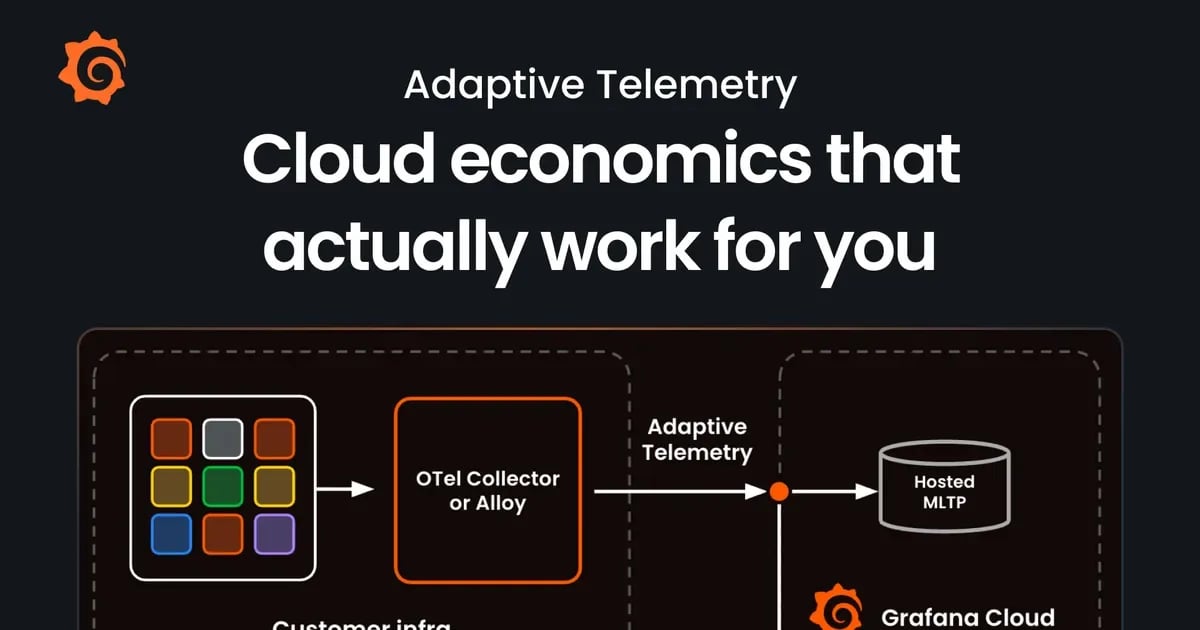
Break the link between data volume and your observability bill with Adaptive Telemetry
In the AI era, where telemetry is generated by every model call, tool invocation, and agent step, organizations need more help than ever when it comes to navigating the economics of observability. For a lot of teams, the default response is a "data diet" of shorter retention, which leaves services or environments out…
%3Aquality(90)%2F&w=3840&q=75) %3Aquality(90)%2F&w=3840&q=75)
Break the link between data volume and your observability bill with Adaptive Telemetry
In the AI era, where telemetry is generated by every model call, tool invocation, and agent step, organizations need more help than ever when it comes to navigating the economics of observability.
For a lot of teams, the default response is a "data diet" of shorter retention, which leaves services or environments out of collection, or basic sampling, which is more guesswork than strategy. Either way, you end up cutting to control the bill, and you risk losing the very data you need during an incident.
Your costs shouldn't scale with how much data you ingest. Instead, they should scale with the value you get from it, so you only pay to keep the data that earns its place.
That’s what Adaptive Telemetry is built for, and organizations such as Rapid7 are already seeing the results.
“Moving to Grafana Cloud and using Adaptive Telemetry cut our metrics costs enough to fund logs and traces as well," says Carl Eastman, Principal Software Engineer, Rapid7. "Our visibility went up while our costs went down, and dashboards and queries are faster and less noisy.”
You can already use Adaptive Telemetry for all your observability signals, and we're continuing to build on that foundation so you can get even more precise about which traces you keep, improve your logs economics, and get more from Adaptive Metrics with less toil. Here's how that looks in practice.
Keep only the traces that matter, and cut volume by 90%
Traces are where the data diet hurts most. Many teams sample with a fixed percentage, which treats a slow checkout request the same as a routine health check. Cut the percentage and your bill drops, but so does the chance that the trace you need is still there when something breaks.
Adaptive Traces already handles the hard part (tail sampling) without you running a pipeline. Three newer capabilities make retention even more precise.
Automatically keep your most valuable traces, without the policy toil
Volumetric sampling gives you a more valuable sample than probabilistic sampling does. It spreads your sampling budget fairly across services and request types, so low-volume services aren't crowded out, and it keeps adjusting as your traffic changes. You set one number (your sampling percentage) without writing complicated policies or tuning them by hand. In Grafana Labs' testing, it delivered about 25% higher information density than probabilistic sampling at the same volume.
%3Aquality(90)%2F&w=3840&q=75)
Keep at least one trace from each footprint, so there’s always something to reference
Diversity sampling makes sure you always have something to look at. Every 15 minutes, it stores a unique combination of attributes such as service, route, and status codes. When your environment changes, you don't have to write and update custom sampling logic to catch a new service or code path.
%3Aquality(90)%2F&w=3840&q=75)
Sample aggressively and still retrieve the exact trace you need
The ability to query traces dropped by Adaptive Traces is your safety net. Adaptive Traces keeps every dropped trace queryable by trace ID for 24 hours after ingest. If you have the trace ID from a log line, a support ticket, or a testing framework, you can retrieve that specific trace even if Adaptive Traces dropped it. Dropped traces don't appear in search or aggregations, so it's a lookup, not a replacement for sampling the traces you want to search. That's what lets you sample aggressively with confidence.
Together, you can use these features to cut trace volume significantly without wondering whether you cut something you needed.
Volumetric anddiversity sampling, along with the ability toquery dropped traces, are all generally available.
Improve your logs economics without giving up the data you might need
Logs add up fast, and a lot of what you store never gets looked at. Adaptive Logs already finds the log patterns nobody queries and trims them on the way in. Now, two new capabilities help you cut earlier, and with more confidence.
Drop unwanted logs at the source and cut egress and network overhead
Fleet-managed Adaptive Logs uses the same drop rules and exemptions you already use and applies them directly to the collectors you already run, through Fleet Management. Matching logs are filtered out before they ever leave your environment, so you save on egress and network overhead on top of your storage savings.
Adaptive Logs creates and keeps the collector pipelines in sync for you, so there's nothing extra to write or maintain. Pattern-based recommendations still run in Grafana Cloud for everything that remains.
%3Aquality(90)%2F&w=3840&q=75)
Keep what you might need, retain it in low-cost storage
Teams are understandably cautious about dropping logs. After all, a dropped line can't be recovered, so it's understandable when teams hold back. Archive and replay changes that.
Archive routes logs to your own low-cost object storage instead of dropping them. Replay brings them back on demand when you need them for an investigation, an audit, or a compliance request. You keep the savings from not indexing low-value logs, without permanently losing data you might need later.
%3Aquality(90)%2F&w=3840&q=75)
That's the shift: lower costs, with a way back to the data you might need.
Fleet-managed Adaptive Logs is in public preview. Archive is in public preview, and replay is coming soon. Sign up for the private previewto get early access.
Get more from Adaptive Metrics, with less toil
Adaptive Metrics is already good at finding the waste. It looks at how your metrics are actually used across dashboards, alerts, recording rules and queries, and it recommends aggregating the ones nobody needs at full detail into lower-cardinality versions. The catch is that someone has to review each recommendation, and for platform teams, that review quickly becomes its own chore. Rapid7's Eastman knows the feeling:
“Before, finding waste meant someone manually digging through metric cardinality and log volume, and the job never ended because new services kept adding more," Eastman said. "Adaptive Metrics and Adaptive Logs now do that analysis for us... Our engineers spend their time on the few rules that need human judgment... rather than the whole long tail.”
Apply savings automatically, without reviewing every recommendation
Auto-Apply takes the review off your plate. Turn it on for a segment, and new recommendations are applied automatically as they're generated, with no human in the loop.
You choose where it runs, and you can exempt the metrics you never want touched. Use coverage-first mode to keep pace with usage automatically, or cost-first mode if you’d rather guarantee your series count never increases
%3Aquality(90)%2F&w=3840&q=75)
Auto-Apply is generally available. For the full walkthrough, see our recent blog post on the topic.
Ready for the next wave of telemetry
AI will bring more telemetry, but it doesn't have to bring more cost and more noise with it. Trim what nobody uses, keep the signals that matter, and know the data you might need isn't lost for good. You don't have to cut retention, leave services out of collection, or sample on a hunch.
That matters beyond the bill. When your costs follow the value of your data, the savings are yours to reinvest in broader coverage and better insight, instead of living on a data diet. Rapid7 is a good example. Here’s how they describe it:
“We’re reinvesting the savings in observability coverage rather than just banking them," Eastman said. "Every signal has to earn its place, and the savings pay for signals that do.”
Whether it's metrics, logs, traces, or profiles, Adaptive Telemetry helps you keep what's valuable as your data grows.
Adaptive Telemetry is available in Grafana Cloud. Try it today, and read our docs to learn more!
Grafana Assistant is the easiest way to get started with metrics, logs, traces, dashboards, and more in Grafana Cloud. We have a generous forever-free tier and plans for every use case. Sign up for free now!
منتشرشده در
Grafana Labs Blog
ادامه مطالعه